Full descriptions of all the popular Dodecanese ports, listed alphabetically.
This section is still under construction so there are one or two texts missing though there are usually a few pictures at least.
- Agios Georgios / Yeoryiou

Agios Georgios: The small harbour with a motor boat on the quay
This little fishing village is Agathonisi’s main resort, though with the total population of the island only just in to three figures, it’s not huge!
There’s a beach around the bay, and a sandier one a short walk away. The waters are clear and you can swim off your yacht. Time to get the snorkel out!
There are pleasant walks around the island where you can admire the well kept houses with their walled gardens.
The main town, Chorio, is a short walk inland, and between the two villages you’ll find basic provisions as well as a doctor and a dentist. In Agios Georgios itself, you have a choice of two or three restaurants, a couple of cafe’s and a mini market.
Despite its remoteness, it’s a popular spot with sailors so arrive as early as you can to get the best spot.
- Diafani (Karpathos)

Diafani: The village and bay with a motor boat on the small quay, centre right.
The village’s own website sums the place up quite nicely when it says the locals’ main activity is watching the boats arrive!
Many of the boats come to deliver visitors to Olymbos, about 10km inland, and reputedly one of the prettiest villages in Greece, a claim that in itself leaves me fearing disappointment.
The village has a pebbly beach, a handful of restaurants and a shop offering basic provisions. It’s relatively green and there are some attractive walks but this is otherwise a place that sells itself on the lack of activities. As the village website says; no night life, no entertainment centres, no cloths shops, no car hire, no big hotels, no package tours.
So what’s not to like!
- Emborios / Chalki (Halki)

Chalki Town: Fishing boats in front of the town’s prominent clock tower
It my be only 5 miles from Rhodes but Chalki is a world away from the busy holiday resorts like Faliraki.
It’s a pretty place, its pastel coloured buildings contrasting with the barren hillsides. As you approach you’ll see windmills on the hill tops, and a large castle, testament to a long history.
The island has been inhabited since Roman times and more recently was a major sponge fishing centre, but the decline of this industry has been matched by an exodus of the population.
There were once two towns, Horio / Chorio, an hours walk inland, and the port, Emborios /Nimporio. Horio is now abandoned and with its castle, high on the hill, is well worth a visit. The castle was build in medieval times by the Knights of St John (the same construction firm that build Rhodes)!

Chalki: the Crusader Castle at the now largely uninhabited village of Horio.
The energetic may also head further inland to see the Monastery of St John, one of a large number of religious building in the interior. But many will taken by the calm of the place and head for the beach or a cafe.
There are two beaches to chose from within 15 minutes walk of the port, of which Pondamos is the sandiest (though still shingle in part).
There are plenty of tavernas to chose from, with a handful of shops in between giving you a choice of mini markets, a bakery and a few gift sops to chose from. Don’t expect a wild night life (or indeed any) – you’ll be doing well to find a bar playing some music.
Make sure you arrive with enough water in your yacht’s tanks – there’s no water on the island and supplies bought in by sea from Rhodes do run out from time to time.
- Emporios / Emborios (Kalymnos)
The most northerly village on Kalymnos – the town at the end of the road – Emporios is a cluster of whitewashed houses separated by narrow alleys, on the edge of a beach lined bay.
Beyond the maintained trees and holiday properties on the beach edge, the surroundings are more barren than at Pothia and Vathi, but more typical of the island.
If you fancy a walk, the ruins of Kastri tower and the Cyclopean Walls are up the hillside but most people relax on the beach or in a cafe. You’ve a choice of restaurants and there’s a mini market.
- Emporios / Nimborio (Symi)

Emborio: Fishing boats moorerd off the beach and village of this open bay
Once a commercial harbour, Emporios is now just an anchorage. There’s a beach, rated by some as the best on Symi, a taverna or two and just up from the beach some catacombs, the Dodeka Spilia.
If you don’t fancy leaving your yacht here, it’s only about 45 minutes walk from Symi Town, or you can take a cab.
- Faliraki (Rhodes)

Faliraki: It’s not all nightclubs and bars, but there are nicer and easier destinations
Faliraki has a small harbour at the south of the bay but it’s well guarded by rocks and largely inaccessible to yachts thanks to a bridge near the entrance.
You could try anchoring off but there’s not much shelter and with a beach rammed with bodies and lined with hotels, I’m not sure why you’d want to bother trying – there are better options around Rhodes.
- Kalymnos / Kalimnos / Pothia

Kalymnos Town: The harbour, full of fishing boats, the masts of moored yachts in the foreground
Once the centre of the Greek sponge trade, Kalymnos Town, also know as Pothia, sits in a lush valley at the foot of two hills. These form a natural amphitheatre around the large harbour.
The town has plenty to occupy visitors, with beaches, caves, museums, ruins and a wide choice of eateries all close by.
Harvesting of sponges brought great wealth to the island, reflected in the many fine houses you will find around town with their ornate iron balconies. One of these, the Vouvalis Mansion has been restored for visitors and houses the Archaeological Museum.
However, diving for sponges carried great risks with divers originally descending over 25m for several minutes.
The introduction of underwater suits enabled even greater depth to be reached but unfortunately the effects of decompression weren’t understood and many divers were killed or paralysed.
There are still plenty of sponges on sale and the Nautical Museum includes a display about the history. But sadly, disease hit the local sponges in the 1980’s and although stocks are recovering, many on sale come from elsewhere.

Natural sponges are softer, more durable and more absorbent than synthetics.
Just outside town are the Kefala caves, the best of a number on the island, open daily from 08.30 to 14.00 – take a torch. Just north of the town are the ruins of the Citadel of the Knights of St John (Golden Hand Castle), set high on a hill next to 3 derelict windmills and offering great views.
A couple of kilometres away is Therma beach, one of many on the island of which the sandy Masouri beach, about 9km away is one of the most popular. Buses & taxis will get you around, or there are scooters for hire. If that’s too far for you, try the Folklore Museum in town.
Lining the promenade around the harbour you’ll find a long one of restaurants, cafe’s and bars, offering everything from “traditional” Greek cuisine to the latest in junk food. Those seeking a bit more authentic experience might want to follow the locals to some of the restaurants away from the front, particularly those around the Town Hall and Prefecture Hall.
There’s something for everyone in Kalymnos, except perhaps those looking to get off the beaten track and away from tourists, though it’s not quite as busy as Rhodes or Kos Town!
- Kamari / Kamares & Kefalos (Kos)

Kamari: The beach
The village of Kamari is at the south end of the long sandy beach of Kefalos. The small harbour at Kamari provides good shelter, though if you’re just stopping for lunch you can often just anchor off the beach.
Needless to say, the beach has been well and truly discovered with a number of hotels in evidence.
The Beach Club ashore offers the chance to try your hand at dinghy sailing, windsurfing, kayaking or paddle boarding. Alternatively, take a swim on the pool, lounge on the beach or take a drink at the beach bar.
Kefalos can seem a bit manic during the day with jet skis and speedboats zooming around, so I wouldn’t rush to get there – things quieten down later, though you may hear some music from the hotels. If this is a worry, you might want to consider Mastichari on the opposite side of Kos, or head south to Mandraki on Nisyros.
The village of Kamari is a more attractive proposition. There are several tavernas to chose from and provisions within walking distance. A longer walk (or alternative transport) take you to Kefalos castle, dating from the 15th century. A short cab, scooter or bike ride away, is the Monastery of Agios Ioannis, and the Basilica of Agios Stefanos.
- Kardamena (Kos)

Kardamena: The beach looking north
Once a small village, Kardamena has grown in to a thriving holiday resort. The big attraction is the long sandy beach. So long in fact that most of the hotels could genuinely claim to be no more than 5 minutes from the beach!
Amongst the modern hotels, you’ll still find plenty of signs of the original village. There are even some Roman ruins and several old churches.
The resort was once prone to some of the worst excesses of “Brits on Tour”. However in recent times, it’s become more of a family holiday destination, helped by an influx of non British holiday makers.
There’s still plenty of nightlife for those that want it, and water sports on the beach. But there’s a pleasing number of seafood restaurants, and plenty of shopping and provisions available.
It’s probably not going to be the highlight of your yacht charter itinerary but then it’s got some pretty stiff competition.
- Kastellorizo / Kastelorizo

Kastellorizo: Town buildings
You’re more likely to visit this Greek island when sailing in Turkey – it’s much closer to the Turkish coast than it is to any other Greek territory.
The island has been hotly fought over for centuries with the castle after which the island takes it name having been knocked down and rebuilt several times. There are still many ruins behind the town.
On the front though, it’s a mass of brightly painted mansions, many with wooden balconies, with plenty of shops, restaurants and cafes to occupy you. A walk up the hill is rewarded with excellent views of the Turkish coast.
For those seeking culture, there are a number of historic ruins, monasteries and churches to explore, along with a small museum.
Surprisingly , there are no beaches but you can swim off the rocks. Do also take a trip around to the south east of the island, where you can dinghy in to the Blue Cave.
Although Greek, there’s a long tradition of welcoming yachts from Turkey, and something of a disinterest in the usual formalities. However, I do recommend you check the latest situation with your charter company before visiting.
- Kefalos (Kos)
The long sandy beach stretching around this wide bay is the obvious attraction at Kefalos. The Beach Club ashore offers the chance to try your hand at dinghy sailing, windsurfing, kayaking or paddle boarding. Alternatively, take a swim on the pool, lounge on the beach or take a drink at the beach bar.
If you fancy exploring, take a stroll in to the village. A longer walk (or alternative transport) take you to Kefalos castle, dating from the 15th century. A short cab, scooter or bike ride away, is the Monastery of Agios Ioannis, and the Basilica of Agios Stefanos.
The bay is rather exposed and unless it’s good weather I wouldn’t spend the night here at anchor. However, the Beach Club may have some moorings laid, which if you’re going to use their facilities, they may be willing to let you tie up to.
- Kos Town

Kos Town: The Castle of the Knights of the Order of Saint John
Kos is an ancient settlement, originally founded on agriculture and fishing, with one of the largest market places in the ancient world, and known for its wines and silk. The home of Hippocates, the island still shows much evidence of past glories but today the main industry is tourism.
There’s plenty to do and see whether your aspirations are cultural or retail. The castle of the Knights of St John is right next to the harbour and unmissable.
The ancient hospital, the Asclepion takes a bit more effort being about 4km out of town but is worth a visit. Back in town, there’s a restored Roman mansion with mosaic floor, the Plane Tree, under which Hippocrates allegedly taught, and the Archaeological Museum.
The town offers all the shopping opportunities you’d expect of a tourist centre, with plenty of restaurants, cafe’s and bars to rest your weary limbs. It’s here that you notice the impact of tourism, with increasing numbers of fast food establishments.
Just outside town there’s a beach, with more around the island. There are plenty of scooters and cars for hire if you fancy exploring the rest of Kos.

Kos Town: Mosque and cafe
Come the evening the town really bursts in to life. If you’ve found the rest of the Dodecanese a bit sleepy, now is the chance to let your hair down and party, with a choice of nightclubs and countless bars at your disposal.
The town bears the noise and antics of the night owls fairly well and hasn’t yet sunk to the excesses of some of it’s holiday island rivals. But I wonder whether it will continue to do so – you might want to visit sooner than later.
- Ladiko (Rhodes)
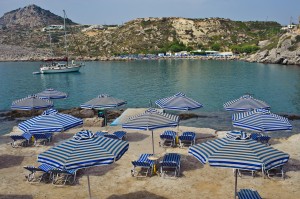
Ladiko: The bay with a yacht at anchor
This well sheltered anchorage is only a couple of miles south of Faliraki so don’t expect a quiet uninhabited bay!
However, once the sun bathers have gone home it’s a fairly peaceful spot, albeit strewn with sun loungers and umbrellas.
The beach is sandy but with plenty of rocks so watch your toes. There are several cafes ashore.
- Lakki / Porto Lago (Leros)
A superb natural harbour, Lakki is a town unlike any other in the Dodecanese. Art Deco and futuristic buildings line the wide buildings with little sign of the narrow alleys and traditional buildings one would expect.
The buildings date from the Italian occupation, when the bay was a major Italian Naval Base. Some are now falling in to disrepair as more traditional structures spring up which detracts slightly from the pine lined streets and green spaces.
Lakki is a bit lacking in sights – head a couple of miles north to the island’s capital if you want some ruins and churches to explore. There are no beaches immediately to hand either, though again, plenty a short ride away.
Lakki is well worth a visit just because it’s somewhere a little different – a bit of Italy planted in Greece.
- Lindos (Rhodes)

Lindos: The north bay, town and castle
Originally the capital of Rhodes, Lindos is steeped in history. There are three attractions – the beach, the town and the acropolis within the medieval castle.
Your perception of Lindos is likely to be heavily influenced by when you visit; both the time of year and the time of day.
In high season the place gets packed, much less so out of season. First thing in the day, before the trip boats and coaches arrive from Rhodes it’s much more pleasant than later on.
The beaches are sandy though at busy times you’ll struggle to see the sand for bodies.
The town is as mass of narrow alleys running between whitewashed buildings. It’s firmly geared to the tourist market with countless restaurants, bars and souvenir shops. However there are also several supermarkets should you need to replenish your provisions.
The acropolis is fascinating. The site has been repeatedly developed and built over by the Dorians, Greeks, Romans, the Knights of St John, and the Ottomans. The ruins on view cover all these periods, in varying states of ruination. Being at the top of the hill it’s a bit of a hike but you can always take a donkey ride up.
Outside the acropolis the remains of a Roman theatre have been found. Excavations continue – who knows what will be uncovered next.
- Lipsi

Lipsi: Fishermen mending nets on the quay, in front of the church
With it’s whitewashed buildings and blue domes, Lipsi is like a miniature version of Santorini, but at a lower altitude, and with better beaches and fewer tourists!
It’s a great place to relax with virtually no traffic and everything within walking distance. Indeed, the island is small enough you could walk from one end to another.
There are three beaches nearby, Lendou/Liendou, Kambos and Elena. Lendou is closest, about 10 minutes from the harbour and is mostly sand.
There are a couple of churches to visit, Panaghia of Haros about a mile out of town, and Aghios Ioannis next to the main square where you’ll also find the Ecclesiastical & Folklore Museum.
A few small shops and a couple of tavernas complete the set up. So pull up a chair in the main square and unwind.
- Livadia (Tilos)
The little harbour at Livadia is actually the main port for the island. Once populated by miniature elephants, remains of which have been found on one of the caves, Tilos is now a bird sanctuary.

Livadia: Looking across the harbour
There are plenty of traditional buildings in Livadia, with the main concession to tourism being the many restaurants. There’s a good but pebbled beach in town but if you need more to enliven your day, there are 5 castles spread around the island and in the capital, Megalo Chorio, 3 miles north of Livadia, a museum about the dwarf elephants.
It’s all fairly sleepy and subdued; well worth a visit before too many people find it.
- Mandraki (Nisyros)

Mandraki (Nisyros): Houses crowd the waters edge The island of Nisyros is essentially a volcano, which is still technically active. Mandraki, home to the majority of the island’s 1000 strong population is on the north west corner.
The village is a maze of pebbled streets and alleys, between the whitewashed and natural stone buildings with their wooden balconies.
Amongst these and particularly around the main square you’ll find a good selection of restaurants, coffee shops and bars. It’s not a wild party town but you definitely won’t starve! There are plenty of trinket buying opportunities too.
You should try to seek out the local speciality, a non alcoholic drink called soumada, made with almonds, honey, baby tomatoes and capers.
Culture vultures will find plenty to do in town. The Castle of the knights of St. John sits 150m above the town, giving excellent views. The monastery of Panagia Spiliani is close by, being both the largest monastery on the island and built in a cave.

Nisyros: The volcano crater For those wanting some beach time, there’s a stony beach on the edge of town but a sandier option about three miles east of town (catch a bus or hire a scooter).
Of course no visit would be complete without a visit to the Volcano. There are in fact a number of caters around the island but the one that everyone heads for is of course the largeset, Stefano.
You’ll have no trouble getting there – the buses line up at the harbour. You can walk right down in to the crater where the last eruption took place in 1888.
It’s hot so take strong shoes or you’ll find your soles melt. It’s also rather smelly with a strong whiff of sulphur.
For those wanting to know more there’s even a volcanological museum – trying saying that after a few drinks!
- Mastichari (Kos)

Mastichari: The beach
It’s nice to find somewhere on Kos that seems to have escaped the ravages of mass tourism. The small fishing village of Mastichari welcomes the quieter kind of visitor.
There’s a good sized beach with much of the water based activities wind powered and kept to one end. A short walk inland there’s the ruin of a Christian Basilica with a mosaic floor.
There are several restaurants to chose from, some specialising in fresh fish from the boats based here. There’s a small assortment of shops, including a supermarket.
The only possible drawback is depending where you’re moored, and on the local ferry timetable, you may be asked to move your boat around 7am. So best to get there in reasonable time and try to secure a place where you can still have a lie in.

Mastichari: Fishing boats in the harbour
Compared to much of the Dodecanese, the surroundings are surprisingly flat. But it’s pretty place and one of the few places around Kos where you can get away from the crowds and enjoy some peace.
- Panormitis (Symi)
Sailors stopping the night get to see Panormitis at it’s best. This bay, on the south west of Symi, is a tranquil contrast to the bustle of Symi Town, but only once the plethora of trip boats have left for the day.

Panormitis: The monastery and quay
The central attraction is the Greek Orthodox monastery of the Archangel Michael which dominates the shore and which draws pilgrims from far afield. However, many come just to enjoy the sandy beach and some swimming.
The current Venetian styled monastery dates from the 18th century but there have been a succession of churches here, on what was once the site of a Roman temple. The monastery house two museums, one dedicated to the ecclesiastical, particularly the many offerings brought for the Archangel by visitors, the other focused on folk art of the island. You should also take some time to explore the courtyards and rooms of the monastery itself.
Otherwise, there’s little here – just a few restaurants and basic provisions.
- Panteli / Pandeli (Leros)

Panteli: A yacht entering the harbour
This traditional Greek fishing village is clearly identified by the line of windmills on the hilltop. It lives an odd double life, with fishing boats moored up just feet from large yachts.
So far it’s holding it’s own; you’ll still find fishermen sewing their nets and be greeted by the locals as a welcome guests rather than a source of revenue.
There’s a beach, sandy in parts for those that fancy a swim. Provisions are available in the village but for a better choice, walk up the hill to Plantanos. You don’t have to go as far for sustenance – there are restaurants and bars scattered along the front.
You do get the odd bar playing music late in to the evening but it’s all rather low key, not the sort of place anyone would go for a wild party. You’re more likely to find yourself in the shade of a tamarisk tree sipping a coffee or ouzo in the company of the locals.
- Patmos Skala

Skala Patmos: The town and harbour with a ferry in port
Skala is the main port on Patmos, a couple of kilometres north of the capital, Chora (or Hora). The island is reputedly the place where St John wrote the Book of Revelation.
Patmos is a popular stopping off point for cruise ships as the high number of souvenir shops will attest.
There are several monasteries of which the main attraction is the Monastery of St John, in Chora. The smaller Monastery of the Apocalypse marks the spot where John heard the voice of God which prompted the book.
If monasteries aren’t your thing, the island has a number of great beaches, many sandy. Several of these, including the most popular, Kambos, are just up the coast to the north of Skala.
Skala itself is a pleasant town. Much of the construction is relatively new, dating back to the Italian occupation in the first half of the last century. One bi-product of the cruise ship and ferry traffic, is a huge selection of restaurants so you will dine well.
- Pigadia / Port Karpathos

Pigadia: The sea front and east harbour
The capital of the island, Pigadia is also the main port. Not that it’s a large place – the total population of the whole of Karpathos is only around 6000.
Pigadia sits at the south end of a long beach which gets sandier the further you go from town.
Heading out in the opposite direction, there’s the Cave of Poseidon, about a mile from the harbour and accessible only by sea.
The town itself has the ruins of the original settlement, Potideon, and a small museum. And of course there are all the shops and service you would expect in a small town.
There’s nothing wrong with Pigadia, and if you’d never been to another Greek island you’d love it. But for a yachtsman there’s nothing much here that you couldn’t find more accessibly elsewhere. Except of course, being one of the more outlying Dodecanese islands, you may want to visit if only because not many others do.
- Pserimos

Pserimos: The village and beach
This is one of the smallest inhabited Greek islands with a declining population now thought to be down to double figures.
There are no cars as there are no roads. Provisions not sourced locally arrive by boat. As do the tourists.
The arrival of the trip boats multiplies the population for a few hours. But after a quick swim, a lounge on the beach and some shopping for a few trinkets they’re gone and the visitor to locals ratio evens up!
You’ve a couple of restaurants on the beach to chose from, then sit back and think how lucky you are to be there.
- Rhodes Town

Rhodes Town: St Angels Tower looks over the ferry harbour, with the walled city behind
If you’re hoping to see one of the Seven Wonders of the World, the Colossus of Rhodes, I’m afraid it collapsed in an earthquake around 226 BC, having stood for only just over 50 years.
No matter, Rhodes has plenty to offer, including copious Roman ruins, one of the best preserved walled Medieval cities, the Italian built Art Deco “new town” and of course plenty of beaches and endless shops.
You can’t avoid the Medieval city, and with its cobbled streets lined with souvenir shops, cafes, bars and restaurants, you don’t need an interest in history to enjoy it.
The walls and the huge gates were build by the Knights of St John and within them, besides the myriad retail opportunities, you’ll find the Roman Temple of Venus, the Palace of the Grand Masters, countless mosques and churches, including the Mosque of Suleiman the Magnificent, and several museums.

Rhodes Town: Entrance to the Palace of the Grand Masters
The Palace of the Grand Masters, originally build by the Knights was partly demolished in grand style in 1856 when dynamite stored there exploded. It was rebuild during the Italian occupation in the 1930’s as a holiday home for the Italian King, and later, Mussolini.
The Palace is now a museum, with many of the rooms open to the public and displays including mosaics, sculptures and frescoes covering both ancient and medieval Rhodes.
Leading away from the Palace is Knights Street, a cobbled walkway along which lie the inns of the Knights, again restored by the Italians. Wandering on through the alleyways there are Gothic churches and the Square of the Jewish Martyrs, commemorating the local Jewish community, crushed by the Nazis.

Rhodes Town: One of the many souvenir shops in the old town
Also in the Old City you’ll find the Archaeological Museum, located in the Hospital of the Knights. Here you’ll find relics from sites around the island. There’s also the Municipal Art Gallery, and the Jewish Museum. All in all, probably more museums than you need!
As you stroll through the Medieval City you’ll never be far from refreshment, though sadly much of what is on offer is something of a betrayal of Greek cuisine. It’s much the same in the souvenir shops – there are some nice items but there’s a far amount of tat to dig through.
Outside of the walls you may fare better (or maybe not). Next to the harbour is the New Agora, an Art Deco fascade built by the Italians (they didn’t just do restorations)! behind which lie courtyards with restaurants and markets stalls.

Rhodes Town: A knight in armour guards the walls
If you’ve still not had enough history, catch a cab a couple of miles west of the old city where you’ll find the Acropolis. The vast remains of the Roman settlement are still being excavated (they didn’t start until early last century), but amongst the building already found are the Temple of Athena Polias, the Gymnasium, the Stadium, the Odeon and the Library.
If that’s not enough, in the modern town you’ll also find a theatre, a casino, and a good range of shops. There’s also the Aquarium where you can see the fish you’ve been swimming with (and a few you haven’t)!
Of course, the main reason most people go to Rhodes is for the beaches. You’ve plenty to chose from around the island but the nearest to town is Elli beach, at the north top of the town near the Aquarium. Its position does mean it gets busy and if you fancy somewhere quieter you might want to hire a scooter or hop on a bus and head somewhere more remote.
There’s plenty to occupy you in Rhodes and it’s a very interesting place to explore for a day or two. You’ll not be alone though – the secret is out. It has however survived the tourist onslaught better than other places on the island
- Symi Town

Symi Town: Yachts on the north quay of the inner harbour
Once a major shipbuilding and sponge fishing centre, Symi is now primarily a tourist destination. The island has had a chequered history but after much restoration (heavily controlled by the authorities) its multi coloured buildings now make a spectacular sight.
The harbour of Symi town (also called Yialos) includes a small nautical museum and is connected to the main town (Chorio) by steps; about 350 of them! It’s worth the walk up for the views at the top, not to mention the superb 19th century buildings you will pass on the way up.

Symi Town: The north side of the harbour with local boats on the quay
The locals are evidently a religious lot; there are over a dozen churches and a number of smaller chapels. The castle was sadly destroyed in the second world war but as you wander the narrow streets you can visit The Museum, a restored Pharmacy and an 18th century mansion.
If you fancy going further afield, there are plenty of other sites to see around the island, including the impressive Panormitis. you can take a taxi or hire a car from the harbour.
If that’s all too much, take a seat in one of the many cafe’s and restaurants and watch the world go by. It gets even better once the day trippers from Rhodes depart and an air of calm descends.
There are all the facilities you’d expect from a small town, including provisions, souvenirs and banks with ATM’s. If only all small town were as impressive.
- Vathi (Kalymnos)

Vathi (Kalymnos): The harbour
This picturesque village lies at the end of one of the two green valleys on Kalymnos (the other is at Pothia).
Entering the bay through it’s fjord like entrance, you can see the orange and lemon trees stretching up the lush hillsides.
The village that now stands on what was once the settlement of Rina is a simple affair. You’ll find basic provisions and there are a handful of restaurants to chose from.
For the energetic, there are some pleasant walks on offer and there are some minor ruins and a prehistoric cave in the area if you need something to aim for. However, this is a great place to just sit in the shade of the bougainvillea with a cold beer and watch the fishermen coming and going.