Full descriptions of all the popular central Dalmatia ports, listed alphabetically.
- Baska Voda

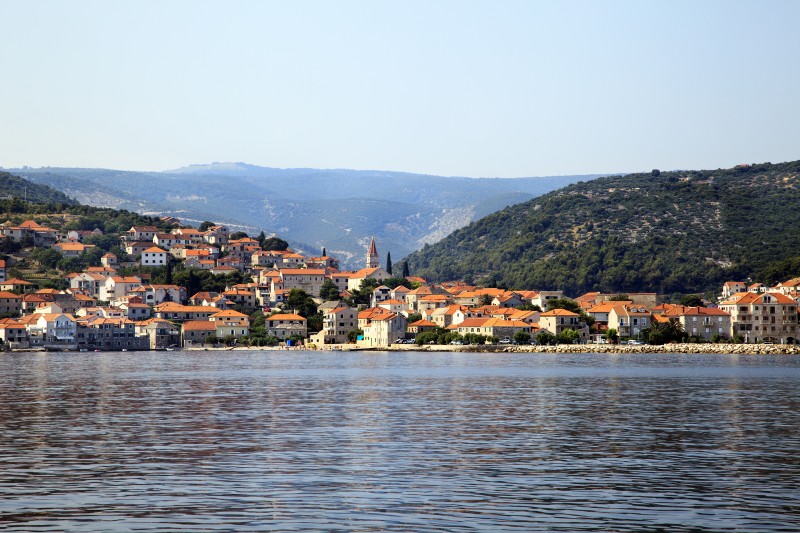
Baska Voda: The town, harbour and coast looking south
Continue reading →
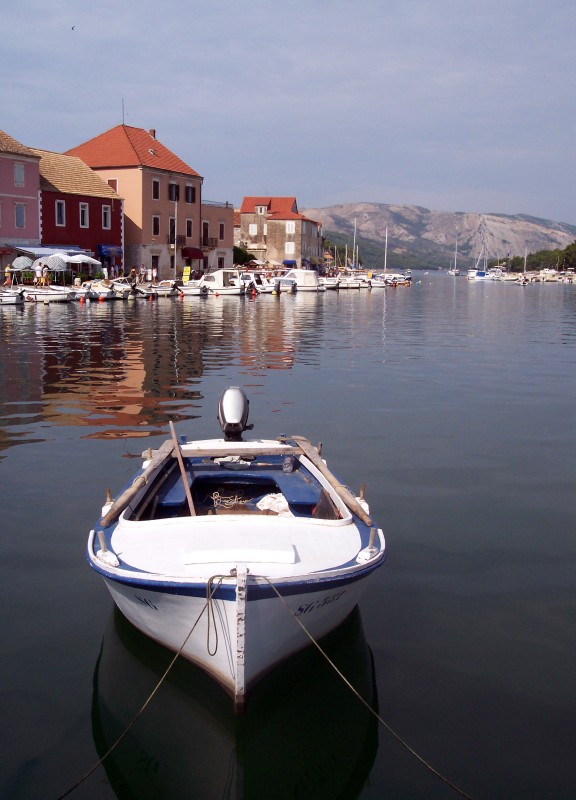
Baska Voda: The beach, town and harbour, with mountains behind
- Bisevo
Bisevo is a small island about 2.5nm south west of the island of Vis. It is famed for its Blue Cave. The morning sun creates a blue light inside the cave, whilst objects in the water appear silver.
The limestone cave was originally accessible only via underwater channels. However in 1884 an opening about water level was made and the cave is now a hugely popular tourist attraction.
Visiting Bisevo by Yacht
For the best effect, you need to visit late morning. You can only enter in a boat with paddles (ie you can use your dinghy but not an outboard). The Blue Cave (also known as the Blue Grotto) is on the east side of the island, in Balun Bay. There is a small anchorage in the bay just to the north but even if you manage to get in, I’d leave someone capable on board. More likely you’ll have to float offshore as the water elsewhere are deep.
There’s an entry fee during July and August of 50kn (about £5) for adults, 25kn for children, free for under 6’s. At other times the rates are 40kn for adults and 20kn for children.
Boat Trips to Bisevo
If you don’t fancy battling it out with all the other yachts at Bisevo, there are plenty of trips on offer from Komiza and Vis Town as well as some from further away such as Hvar Town. These often also include a visit the Emerald Cave where a similar lighting effect gives a green hue.
Continue reading → - Bobovisca (Brac)
Bobovisa sits at the head of a two armed bay. The main village is a little further inland and was founded by migrants from a single village in Bosnia in the 17th century.

Bobovisca: Aerial view of the two limbs of the bay However, they evidently weren’t the first settlers. There are been a large number of archaeological discoveries around the north arm, dating back to the 5th and 9th BC, including helmets, jewellery and money.
There is some quay space in the south arm, called Bobovišća na Moru. There is room to anchor or pick up a mooring buoy there, or in the north arm, called Vičja Luka (the witch’s port). Many local myths surround Vičja Luka as the name implies.
There is a restaurant and a grocery store which offers locally made travariça (a spirit), goats cheese and olive oil.
The most notable building is the mansion on the south side built by the Gligo family, wealthy merchants from Dubrovnik. This was originally a fortified warehouse for grains, oils and wine, complete with openings for guns and canons. The family then converted the building in to a holiday mansion for the well to do. It continues in this role today.
On the north side, is the home of one of Croatia’s famous poets, Vladimir Nazor. The house retains a collection of his possessions. Further up the hill is the monument he built to his three sisters.
Continue reading → - Bol (Brac)
The oldest town on Brac, Bol sits at the foot of the highest mountain in the Adriatic islands, Mt. Vidova Gora. The area is rich in history but the main draw is Zlatni Rat beach.

Bol: The beach at Zlatni Rat, west of the harbour
This V-shaped pebble and sand beach sticks out to sea – the name means Golden Horn. It’s about a kilometre west of the old town. The town and beach are linked by a promenade lined with pine trees and gardens.
It’s worth taking a wander around the winding streets of the old town. Culture vultures should head for the Dominican monastery which dates from the 15th century.
The monastery houses a museum containing many artefacts found locally including marine relics, a good collection of coins, and paintings. There’s also a .botanical garden.
The town provides a good base to explore the local area with attractions including Dragons Cave where a ruined monastery is built in to a cave.

Bol: The town and sea front
The town has all the facilities you’d expect of a moderate sized holiday destination. You can hire scooters, quad bikes and cars in town. There’s also scuba diving on offer. Throughout the season, there are various concerts and festival events, culminating in the carnival parade in mid September.
The town is a bustling holiday centre and you’ll find a good choice of restaurants and bars, as well as provisions. So all in all you’ll find plenty to keep you occupied.
Continue reading → - BristContinue reading →

Brist: A stunning day stop but a bit exposed for an overnight stay
- DrasniceContinue reading →

Drasnice: A daytime anchorage
- Drvenik Veliki / Luka Drvenik (Drvenik Veli)
Drvenik Veliki is a great place to relax, at one with nature on this rugged island. It’s the only town on the island but the population is less than 200. The island’s economy depends on fishing, olives and, you guessed it, tourism. But this is no swinging holiday resort.
Drvenik Veliki: Houses line the quay of this small fishing village
Take a stroll though the olive groves and visit the 16th century church of St George. You can also visit the 18th century church of St Nikolas, but that one is not yet finished. Much like Marina Zirona, on which work now seems to have stopped with just the breakwater built.
You can take a swim in one of the may rocky coves nearby, but if you want a sandy beach you’ll need to go a bit further.
Drvenik Veliki does however have all you need. There is a handful of restaurants and bars, and basic provisions are available. Chill out, that’s enough.
Continue reading → - GradacContinue reading →

Gradac: The popular beach. You can anchor in the bay if the harbour is full
- Hvar

Hvar: The Venetian Fortress and city walls
The capital of the sunniest island in the Adriatic, Hvar is rather schizophrenic. In high season it’s an aspiring St Tropez where the jet set can party the night away before recovering at one of the upmarket beach clubs. At quieter times its a historic cultural centre and a must see destination for your yacht charter.
Hvar was founded on fishing and agriculture. Rosemary and lavender supplemented the usual vineyards and olive groves, and can still be found in the shops.
In the 13th century the Venetians built the impressive defensive walls you can still see today. The Ottomans were held off for any years and the Arsenal provided vital facilities for repairing the galleons.
In 1571 the town was sacked by the Turkish fleet. Worse was to come: In 1579 a lightning strike hit the gunpowder store, destroying much of the town, including the two original fortresses.

Hvar: The centre of the old town
Hvar was rebuilt and many of the buildings can be seen today. Life revolves around the huge piazza, one of the largest squares in Croatia. Around the square you’ll find St Stephens Cathedral, the rebuilt Arsenal, the Bishops Palace, the Governor’s Palace and other public buildings.
The town then became a key centre of Croatian literature, painting, sculpture and architecture. A number of famous Croatians come from Hvar. The Arsenal now houses the historic Theatre of Hvar and the Gallery of Modern Art.
The spirit continues with the Hvar Summer Festival which sees events on many days between late June and late September, ranging from classical concerts by international performers to plays from local amateur dramatics groups.
The centre of town is pedestrianised so you can walk the marbled streets without fear. Shopaholics will find boutiques a plenty though prices can be expensive by Croatian standards (though cheaper than St Tropez)!

Hvar: Another busy day in this very popular harbour.
It’s well worth taking a walk to the now solitary fortress which provides excellent views and a cafe to refresh you before you head back down the hill.
Hvar is renowned for its vibrant nightlife in high season. The clubs include the famous Carpe Diem and it’s associated Beach Club on the off lying island of Stipanska, which has drawn guests such as Prince Harry and Paris Hilton. The evenings often feature sets by internationally known DJ’s (so well known even I’ve heard of some of them)!
The one drawback is the sheer popularity of the place. Except at the start and end of the season, your chances of getting a berth or mooring buoy are slim, even if you arrive in the morning.
Anchoring in Hvar bay is now forbidden in the harbour.
Further out, the depth and swell from passing ferries make anchoring untenable in anything but the calmest weather.
As Hvar is a mecca for the rich and famous prices at the height of the season can seem rather steep. If you want to get a seat at the “big table” with walk ashore access you will have to fork over in excess of 50€ plus another 20-50€ for power, water and rubbish collection (based on a 12m yacht 2015) There are 15 walk-ashore berths available on the east side of the harbour and approximately 15 mooring buoys on the west, some of which allow you to tie to the shore. Mooring buoys are a fairly competitively priced 25€/night for a 12m yacht (2015). Rubbish collection attracts an extra fee.
Hvar is a very popular place and is usually packed by lunchtime so it pays to time your visit to arrive mid-morning if you really want a front row seat. The harbour is a choppy place at the best of times due to the comings and goings of trip boats and water taxis but pay close attention to the weather here as even light breezes from the west through to southeast can set up an uncomfortable slop.
If you just want to stop briefly, the harbourmaster allows up to one hour free. Take note; if you go over this time limit and you will be charged a full day. Sometimes the buoys on the west side are available in the morning and again you can use them to re-provision or make a quick stop to see the town and will not usually be charged for the privilege.
If you can’t find space in Hvar you do have the option of the ACI Marina at Palmizana or take a buoy or anchor between the islands to the south of Hvar. Water taxis operate between these places and Hvar but there are also restaurants available here.
There are other marinas or harbours on Hvar Island from where you can travel overland.
I’d recommend trying to visit Hvar somehow during your yacht charter but even the most determined bareboat crews will probably have to do so without their yacht.
- IgraneContinue reading →

Igrane: The town with prominent church spire from the south. The quay and bay is just to the east
- JelsaContinue reading →

Jelsa: The harbour entrance and approaches showing the breakwater, with Brac Island in the distance
- Kastel StariContinue reading →

Kastel Stari: Old buildings and small boat harbour
- Komiza (Vis)
Komiza: The church of St. Nikola sits on the hill above the town
Komiza has a reputation of being slightly rough around the edges and the locals like to keep it that way! Once the lair of pirates, the picturesque 17th and 18th century village of Komiza is a lively place to spend the night and a lot of Croats talk fondly of Komiza’s bohemian ways. Raise your colours and drop into Komiza on your sailing holiday for a different view of Vis.
More exposed than the port of Vis, at Komiza it is advisable to keep a weather eye out for wind changes and be prepared to leave if necessary to seek shelter elsewhere on the island. The harbour at Komiza can also subject to katabatic night winds so take care when mooring up and allow extra room or place more fenders between yachts to avoid damage.
There are several ways to spend the night in Komiza. There are about 40 mooring buoys laid around the harbour and there is a reasonable amount of room on the quay where power and water are available. Anchoring is permitted but holding can be poor in patches. (Note: in May 2016 the mooring buoys had not been laid)
Mooring buoys will set you back 200kuna/night (approximately 27€ 2013) for a yacht between 10-15 metres long.
Berths on the quayside are charged in accordance to the length of the vessel and what services you require.
In town you will find some excellent seafood restaurants, a supermarket and bars and cafes. A trip to the castle/fort is a worthwhile way to work up an appetite and the small fishing museum provides an insight into the history of this pretty little Venetian styled harbour.
Sited at the foot of the 587m high Hum Hill, Komiza is a fishing town that used unique wooden sailing boats called Falkusa’s. The last original Falkusa sank in 1986 but two replicas, the Comeza-Lisboa and the Mikula can often be seen in the harbour whilst the remains of the last original boat are in the Fishermans Museum.
Komiza was the site of the first commercial fish factory in Croatia/Dalmatia (Built in 1830). In more recent times, the fishing industry grew to merit a local processing plant, the Neptun, though this is now closed and the town is largely reliant on tourists drawn by the many nearby beaches. Wine and grappa, the local wine based spirit, is still produced locally, though mainly for personal consumption.
The town was home to a Benedictine monastery founded in the 13th century and the associated Church of St Nicola still stands. There is also an art gallery in town you can visit.
“Aquarius” is an open air “disco” on Kamenica Beach (east of Komiza) and is the go to place if you are looking to chill out during the day or party long into the night.
On first Saturday in August the skies above the town are ablaze with fireworks and a large feast is prepared to celebrate the fishermen of the island.
The dense buildings and alleyways around the quay house a good selection of restaurants and cafe’s, as well as a supermarket and other food shops. There is also a bank, currency exchange and ATM, as well as a post office.
Continue reading → - Kremik

Kremik: Yachts in the marina
Kremik, just south of Primosten, is a well sheltered bay. The bay houses a large marina. It is a useful resting place when the small harbour at Primosten is full. You can walk over the hill between the two, though the path is not well marked. Ask the marina office for directions. Alternatively you can get a taxi.
Situated about half way between the historc city of Split and the beautiful Kornati and Krk National Parks, Kremik is also a good yacht charter base from which to explore either area. There are several bareboat charter fleets based here.
Its only drawback is it’s about an hours drive from both of the two nearest airports, Split and Zadar. There are closer yacht charter bases to each of these airports. Otherwise, it’s a pleasant if rather unremarkable marina with a restaurant, mini market and chandlers on site.
For more information, the marina has its own website: www.marinakremik-adriatiq.com/en
Continue reading → - Lovisce (Scedro)
- Makarska

Makarska: The town at the foot of the mountains
Continue reading →
Makarska: Aerial view of the town and bays, showing the harbour and quays
- Manastir

Manastir: Ruins of the Dominican Monastery, dating from the 15th Century
Manastir on the island of Scedro is a delightfully serene cove. Somewhat narrower than you expect, the head of the bay is occupied by the crumbling ruins of a 15th century monastery and a lovely restaurant. Surrounded by trees and ancient overgrown gardens, it doesn’t take too much imagination to understand why the site was chosen for contemplation.
The restaurant has provided a couple of buoys for clientele to use. If these are occupied, long-line to the shore where possible.
Ashore there is only the restaurant by way of amenities. However, one of the many walks that are signposted around the island should help you work up an appetite for its limited menu. It is only a short walk over the hill, to the west, to reach the bay of Lovisce. Here there are another three restaurants to choose from.
There is not much left of the old monastery buildings. The place has literally been left to go to rack and ruin so don’t expect too much if you decide to take a closer look. Also take care when walking around the site as some parts of the structure are very unstable.
Continue reading → - Marina / Marina Agana
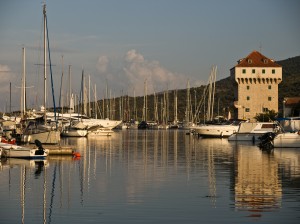
Marina: The distinctive tower in Marina Agana, surrounded by assorted yachts
Marina Agana is a lovely marina located in the village of Marina. Confused?! Once you get here, all will become clear. With its distinctive old customs tower or Kula looming over the harbour, the tiny village of Marina is a very welcoming place. Charter yachts are often picked up or dropped off here as well as the port providing a pleasant overnight stop for those just passing through.
While there are some town quay berths available most people head for Marina Agana. With 200 berths you could be forgiven for thinking that there would always be room for a passing yacht but recently Sunsail have made the wise decision to base a fleet here so at the weekends it pays to phone or email ahead to check there is space. A berth for a 12m yacht is around 68€ per night during the peak months of July and August (2016). The marina offers generous discounts (up to 30%) between Tuesday and Friday if you arrive on a Tuesday. Contact the marina for further details info@marina-agana.hr
If you need help mooring up and the marina staff aren’t immediately obvious, just call on VHF channel 17 and someone will be dispatched to help you in. In the afternoon a pesky wind can blow up from the head of the harbour and things are quite narrow in parts so prepare all your ropes and fenders before entering the harbour if you can. Backing onto the pontoon directly in front of the reception area is the trickiest as any slight breeze becomes a side wind. Take care when picking up the tailed moorings so as to avoid getting them caught on the propeller as you take it to the bow.
Should you fancy a night on the town quay there are 5 tailed moorings located on the south side of the harbour near the Kula/tower. A modest fee is charged for a night here. Water and power is available but for toilet facilities you have to visit the marina.
There are plenty of harbourside restaurants and bars to choose from in the village of Marina as well as a lovely bar and restaurant located near the marina office building. A good supermarket can be found a short walk out of town but there are also limited supplies to buy at the marina. The marina also runs an excellent laundry service. If you need anything just ask the extremely helpful staff at the marina office.
Trogir is a short taxi or bus ride from Marina Agana. Buses leave approximately hourly from the bus stop past the supermarket on the main road. Taxis can be arranged by the marina office. Split is also an option as a day trip by bus or taxi. Split airport is approximately 20 min drive from the marina. Both Trogir and Split are bustling tourist towns and are very attractive in their own ways, however, Trogir would be my pick of places to visit if you only have time for one.
The world heritage medieval town of Trogir is located on a small island linked on two sides by bridges to the mainland and the island of Ciovo. The old town of Trogir is particularly charming with its labyrinth of narrow lanes and pretty café squares. Trogir is an easily managed side trip. A morning or afternoon is all that’s required if the crew as in need of some retail therapy or a touch of rustic glamour. Trogir is famous, and unique, in Croatia for the amount of renaissance and Romanesque architecture. It is pleasure to simply stroll about the back streets and discover surprises around each corner but if you want a more in depth approach you can join one of the many guided walking tours that showcase the old town’s main highlights. There is also an excellent market in Trogir located near the bus station; head outside the town walls towards the mainland and wander over the bridge. You can’t miss it. Anything from Croatian lace to pomegranates is available here.
Continue reading → - Maslinica (Solta)
This little fishing village is a lovely spot and you can still get fish fresh off the boat. The inlet at Maslinica looks out over the little archipelago at it’s mouth and the hills are dotted with pines and olive groves.
Other than fellow yacht charter crews, there are few tourists as Maslinica has no ferry service. It’s wonderfully unspoilt with just a handful of restaurants and cafes, a small supermarket and that’s about it. Arrive with cash as there’s no ATM.
The old baroque mansion makes for an imposing “marina” building, though there’s nothing more than a long quay. There’s not much by way of entertainment but there’s a small beach nearby and pleasant walks up the hillside for the excellent views.
A great place to wind down and relax, Maslinica was my first port of call on my first visit to Croatia and there’s been remarkably little change in the intervening years. A highly recommended stop for your bareboat charter and a regular feature of flotilla holiday itineraries too.
Continue reading → - Milna (Brac)
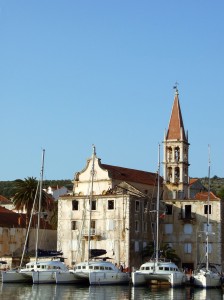
Milna: Yachts in the ACI marina, in front of the town.
The Russians based their fleet here during the Napoleonic wars, in the days before half the harbour in the centre of town was turned in to a marina. Which was probably the most excitement the place has seen.
Described in one review as a great place to relax on account of there being nothing to do, even websites promoting Milna seem to struggle to find much to say about it.
There are four beaches within walking distance, including one for naturists. A good range of shops from the functional to the touristy stretch around the harbour. One commentator who said there were “few good restaurants” I think meant to say “quite a few” – I’ve certainly never had a problem getting quite adequate refreshment.
So don’t be put off by the lack of “sights” – this is a laid back holiday town where you can pull up a chair and watch the world go by.
Continue reading → - Omis
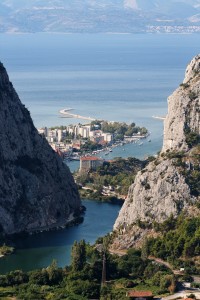
Omis: The town and mouth of the River Cetina from the Gorge
Continue reading →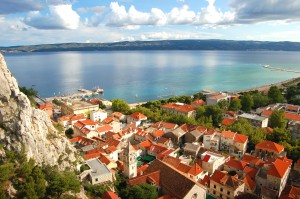
Omis: The town, beach and harbour from the gorge
- Palmizana and the Pakleni Islands

Pakleni Islands: Yachts at anchor
Many yachts use Palmizana and the many nearby anchorages around the Pakleni Islands as a means to visit Hvar without doing battle in it’s busy harbour. Despite its alternative name, Hell’s Islands, it’s a beautiful spot.
A water taxi service from Palmizana makes this a much more relaxing way to see Hvar. The water taxis return with visitors drawn to the many excellent beaches around the Pakleni’s.
The pine clad slopes of the Pakleni Islands provided resin which was melted and used to coat wooden ships, the resin being called paklina.
Tourists first reached here with the establishment of botanical gardens in the 1900’s. Many exotic plants were established and the rosemary now found widely across the island originates from here. The gardens now form the grounds for a boutique hotel.
Palmizana exists for tourists and the 190 marina berths are usually full in summer. The only Croatians here are present to meet the visitors needs so don’t expect any local culture. It does however, feature one of Croatia’s more modern cultural aspects – it’s a popular spot for naturists!
Despite being a scant 2 nautical miles Hvar you could be forgiven for thinking you are nowhere near one of the hottest destinations in Croatia as the ACI Palmizana Marina is surrounded by trees and oozes serenity.
Although straightforward to enter, it pays to be careful when manoeuvring around the marina as depths are uneven and the berths are reasonably tight. If you need help call VHF channel 17.
The marina is open from April to October and prices vary throughout the season. For a 12m boat you can expect to pay 74€ in the low season but prices rise to 88€/night between 01/06-30/09 (2016)
If a bora is forecast do not book a night here. The marina is normally very well sheltered but suffers a large swell under such conditions. A better option should these winds arise would be to make your way across the channel to Vela Garska on Hvar Island.
The marina has all the facilities you would expect (power, water, toilets and Wifi) plus a bar, restaurant and small grocery shop if you don’t fancy catching the water taxi across to Hvar. The water taxi will cost around 100 kuna per person (return price 2015) based on five people taking the taxi. Any less than five and the taxi won’t go. Their operating hours are approximately 8am till 2am. For those that don’t mind a short walk there are a couple more restaurants across the island.
There are plenty of very pleasant walking trails around the island if the crew need to stretch their legs or you want a swim on the other side of the island.
Otok Marinkovac
The island of Otok Marinkovac is one of the tiny islands in the Pakleni group that lie opposite Hvar. Pleasantly treed and surrounded by crystal clear water, the island offers a somewhat sophisticated yet understated sanctuary from the hubbub of Hvar. If you can’t find space in Hvar and don’t fancy paying the higher prices for the marina, Otok Marinkovac makes a good alternative to head for.
Most yachts seek out the anchorage and mooring field located between Otok Marinkovac and Otok Planikovac which provides adequate protection in settled weather. Having anchored here several times I can honestly tell you that this is a lovely spot and extremely conveniently placed for Hvar but it is not without its challenges.
Somewhat narrow, the seabed between the two islands is part sand, part scoured rock and part thick seaweed so choose your anchoring position wisely! If you can’t see sand, try the southern end of the channel. Make sure your anchor is well in if you plan on leaving your yacht here for any length of time or pick up one of the restaurant buoys. Some yachts choose to longline to the islet of Otok Planikovac. This is an excellent idea but make sure your anchor is well in as strong gusts can hit you side on as they race through the channel on their way to ruffle the feathers of the bigwigs in Hvar.
 Sailing Choices Top Tip
This channel is subject to fast flowing currents, particularly if thunderstorms or strong winds are active in the area. It is also worth noting that there is more tidal activity in this area than you would expect of the Mediterranean.
Keep a close eye on the position of your yacht when manoeuvring around moored vessels and do not anchor too close to other boats… collisions do happen.
Also keep a close eye on swimmers and dingy operators as they often find themselves a long way from where they intended to be!
The best spot to anchor in is the back eddy in the southeast end of the bay near the beach bar. This is a particularly sheltered spot and has a good sand bottom. It also keeps you out of the main channel which is very busy during the day. Some moorings are also available here as well as in front of the two restaurants.
Ashore there are the two afore mentioned restaurants, both of which are happy to bring you from, and return you to, your yacht after dinner if needs be. The beach bar to the south of the restaurants is a very laid back affair or you can take a short walk south through the woods to a more sophisticated and luxurious bar/café.
Otok Marinkovac is the most visited island of the Pakleni Islands and water taxis to Hvar run from various points in the channel. During the day the island is teaming with day trippers and quite a few sunbathers of the naked kind as the platter rocks between the southern end of the bay and the upmarket bar/café are designated FKK (Freikörperkultur – Free Body Culture) or a naturist zone. The water taxis also run during the evening but it pays to tee up times with the driver regarding return journeys as they sometimes are not intending on coming back from Hvar later on in the night.
There are no shops etc on the island so if you need supplies you would be best to nip over to Hvar early in the morning to re-provision.
Otok Marinkovac is most famously known for Sipanska Beach located on the south side of the island and the Carpe Diem which offers some of the hottest nightlife in the Adriatic with 5 star service. It is not possible to walk from the anchorage in the channel to this beach but you can catch a water taxi or take you own yacht round and anchor off the beach if the weather is benign.
It’s well worth a visit though you will probably end up wishing you visited 50 or more years ago before everyone else found it.
Continue reading → - PodacaContinue reading →

Podaca: Stone built buildings in the village
- Podgora

Podgora: The town, left at the foot of the lush green slopes
Continue reading →
Podgora: The town and harbour, looking south to the beach
- PovljaContinue reading →

Povlja: The town and quay, with the foot of the jetty just visible far right
- Primosten

Primosten: The walled village on the “island” with yachts at anchor and in the harbour
A small holiday town centred on an island now connected to the mainland by a causeway. The walls that once surrounded the old town have long gone, bar the gate through which one enters the main square.
The square provides an excellent place for various events through the summer but is a bit over restored for my taste. Take a wander through the alleyways where the better restaurants are hidden away (there are supposedly over 50 in total in town) and where you can get a better feel of what life here must once have been like.
Back on the mainland, there are a couple of beaches within walking distance and all the facilities you would expect of a small town including supermarkets, a bakery, butchers, bank with ATM and a post office.
The harbour is quite small and gets full. No problem; just head a bit further south to Kremik. Here there’s a large marina in walking distance of Primosten.
Continue reading → - PuciscaContinue reading →

Pucisca: Yachts and local boats moored in front of the church
- Rogacic (Vis)
- Rogoznica

Rogoznica: The town and quay
Rogoznica is a charming and well protected harbour, marina and anchorage on what can be a very windy stretch of coastline. With its delightful old “island” village there is more to this town than first meets the eye. Pick up a buoy; drop the hook, back onto the quay or choose a marina berth, Rogoznica welcomes all yachts.
The village sits on an island in the middle of a large bay, connected to the mainland by a low road bridge. Lack of space has fortunately prevented this picturesque settlement expanding and it retains it’s sleepy watch over the fashionable and striking architecture across the bay which is Frapa Marina.
Despite its small size, the village contains pretty much all you could need in terms of provisions, restaurants and services. Several grocers and a butcher supplement the daily market with a pharmacy, bank machine and post office also present. There a good choice of restaurants and cafes along the front.
Rogoznica has several options for mooring. The Marina Frapa is a very popular choice and occupies the most sheltered part of the outer bay. This is deemed a luxury marina and has an array of shops, cafes, bars, hotels, swimming pool, sports complex etc. etc etc. attached to the complex. A night in the marina costs 67-89€ a night for a 12m yacht (2016) with catamarans commanding a whopping 80% extra no matter what your beam! July and August considered to be high season. The marina seems somewhat soulless and it is quite a long walk around the head of the bay to the old town but if you want sheltered walk ashore access this is the best option in the area. The marina also has mooring field to the south of the marina. Prices for these are approximately 40€ per night for a vessel up to 13m in length (2016).
One of the highlights of Rogoznica is the “Dragons Eye” a natural saltwater lake located just behind the marina. If you are expecting to just stroll up and take a look it can be slightly confusing to find and I have to confess I never made it. Part of the problem is the marina has made a bar called the Dragons Cave which has been built, burrow-like, into the side of the lake. The bar allows you to drink in the shadowy underground while large seabream cruise placidly by and the rest of the lake appeared to be fenced off which begs the question of an entrance somewhere and entrance fees?? Ask at the marina office and I am sure all will become clear. The lake is known for its waters’ health giving properties and the bottom has a thick layer of hydrogen sulphide which periodically erupts cause the lake surface to “boil” and probably gave rise to the legend of the dragon eye and how the lake came into being.
If you are more interested in being in the centre of things the town quay opposite the marina is the place to head for. There are laid lines and power and water are available. This can be a very choppy place in the afternoon and it is not always the easiest place to back on to as the prevailing wind causes significant sideways pressure so be prepared for anything before attempting your manoeuvres. The price here is approximately 450kuna per night for a 15m yacht (2015).
The third alternative is to head around the “island” and either pick up a buoy east of the causeway linking the old town to the mainland or anchor east of the buoy field or in the lee of the island. (Some yachts also choose to go past the buoy field and anchor in the head of the large bay near an old military jetty but there is no real advantage to this unless it is exceptionally busy.) Having spent several days here in fairly unkind conditions I can tell you that the buoys east of the causeway have the best protection and it is only a short paddle to one of the many small concrete jetties and from there a pleasant hop-skip and a jump to the old town. Buoys were being charged out at around 40€ a day for up to 13m (2015) and anchoring is free.
A couple of words of warning regarding anchoring in this area; There is a cable marked which you must avoid when anchoring. Try to anchor east and north of the buoy field just outside the small boat moorings for the best holding. Large fishing boats come and go at all times of the day and night so try and leave the western side of the inlet free. If you anchor off the back of the “island” be aware that the bottom slopes away sharply and the holding is mostly poor. This is more of a day anchorage in my opinion and I have seen some yachts come to grief when the afternoon breeze picks up. The swimming buoys that have been laid along the beach can make life even more difficult if you inadvertently swing into them while you are trying to sort out your anchor and make a quick getaway!
Onshore the quaint old town of Rogoznica is a lively place at night and the town hosts many cultural events during the summer season. There are a plethora of restaurants to choose from and bar and cafes abound. There are a couple of good supermarkets at the mainland end of the causeway and plenty of bakeries dotted about. In short Rogoznica has pretty much everything you need to resupply.
There are several churches you can visit, swimming spots nearby with a choice of several small stony beaches.
Lastly I recommend you join the locals and take a walk around the pretty island headland on the beautifully constructed coastal path before settling in for an evening’s entertainment; excellent for the health and great for the soul.
Continue reading → - Sesula (Solta)
Sesula is a small narrow inlet at the west end of the island of Solta, just south of Maslinica. It’s a pretty spot and provides good shelter. It lacks a beach but you can swim off the boat. There’s a dive centre here where you can hire scuba gear.
Sesula is made more popular by its proximity to Split and Trogir so can be busy at the beginning and end of the week with charter yachts heading out from and back to the charter bases there.
Aside from the dive centre, in terms of facilities, there is nothing here but two restaurants. However, a 15 minute walk over the hill will take you to the village of Maslinica which will expand your choice of restaurants and offer basic provisions.
Continue reading → - Sicenica
- Split

Split: Seafront with the Roman Diocletian’s Palace and the Cathedral tower
The historical city of Split is Croatia’s second largest city, though with less than 200,000 inhabitants it’s pocket sized. The port is a hub for ferry services to outlying islands and Italy and the city is the cultural centre for the region, so there’s plenty to see and do.
The Diocletians Palace at the centre of the wide esplanade dates from Roman times and features on most Split postcards. However there are many other fine buildings, including the Cathedral Tower (which you can climb to the top of for splendid views) and the National Theatre. It’s a lovely place to just wander around.
If that’s too much effort, take a seat in one of the many bars, cafe’s and restaurants on the front which range from fast food outlets to very upmarket establishments. If watching the boats coming in and out isn’t enough, there’s sometimes free entertainment in summer as musicians or drama groups set up stage on the esplanade.

Split: Some of the many historic buildings
Split is not that user friendly when it comes to yachts. Anchoring is forbidden and the newly renovated Riva (seafront) is being expected to pay its way. It used to be that you could moor here for an hour or so free of charge but now at 800 kuna for a 12 metre yacht, and a minimum charge of 400 kuna no matter how brief your stay (2014,) you could be forgiven for thinking you aren’t all that welcome but if you want to be at the heart of things this really is the best spot. Be sure to call the harbourmaster for permission before approaching the quay. VHF channel 09 or 16.
The only other alternative is the ACI Marina located on the southwestern side of the harbour. The marina has 318 berths but it is still difficult to find a berth at the height of the sailing season. A quick phone call or email ahead can save a lot of time spent milling about or even allow you to time your visit to miss the busy times of the week. Prices fluctuate during the year to a peak of 90€ a night for a 12m yacht between the 1st of June and the 30 of September (2016). The ACI Marina has all the facilities you would expect of a large city marina (restaurants, bars etc.) but alternatively it lies at one end of the Lungomare (seafront promenade) so it only takes a few minutes’ walk to reach the heart of the historic area of the waterfront.
The fuel dock is located on the western side of the harbour. Yachts are allowed to moor at the fuel dock for fuelling up only. Do not moor to the newly constructed western waterfront nearby. This area has not been surveyed and may be shallower than expected!
Navigation tip: Split is an extremely busy commercial harbour. Ships leaving the port have right of way. Do not impede their progress in any way.
For those wanting to while away the night, Split has a number of clubs and late night bars, though these are fairly unobtrusive to those sleeping afloat in the marina.
Split also has a number of museums including two archaeological museums, two art galleries, the Ethnographic (folk) museum and the City Museum. Probably of more interest to the average sailor is the Croatian Maritime Museum with it’s range of models, artifacts and artwork.
All of this is just a short walk (or ferry ride) across the bay from the ACI marina. As you would expect, you will find just about everything you want in the city, including banks, ATM’s, medical facilities, and car hire. There’s an interesting market, just outside the Diocletian’s Palace which is well worth a look, even if you’re not buying.
I always arrive at Split with little sense of excitement but I seem to find something new every time. There really is something for everyone, as should be the case in any good city.
Continue reading → - Stari Grad (Hvar)
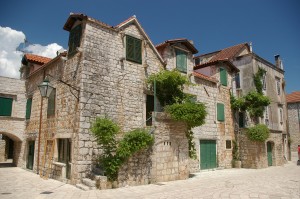
Stari Grad: Old buildings in the town back streets
Stari Grad on the island of Hvar is a harbour with a mission. Stari Grad literally means “Old Town” and Stari Grad is one of the oldest in Europe. Actually, calling it a town is perhaps stretching it – take away the tourists and the population is only a couple of thousand. In 2016 the town will celebrate 2400 years of constant habitation. The more gentile side of Hvar is show here in Stari Grad. The town has a quiet elegance as befits the grand old lady of the region and makes a refreshing change from some of the more exuberant resort centres. A side trip to this delightful old harbour will give you a fresh perspective on the complex history of Dalmatia.
Originally a major wine producing area, the crops were badly hit by disease in the 19th and the town fell in to decline. It has re-emerged as a tourism and cultural centre but fortunately, other than the proliferation of bars, cafe’s and restaurants, the town has avoided the architectural blight of modern hotels.
The harbour of Stari Grad is in a constant state of flux at the moment. Over recent years the local people have worked hard to transform the old quays into a welcoming port for yachts of all sizes. There are 4 options for mooring.
The town quay: The town quay is located on the south side of the harbour. There is now room for around 60 yachts and the berths come complete with laid moorings. Power and water is available. The prices in 2015 were 36 kuna/m/night. Shelter is good here except when strong winds blow from the west or northwest.
Mooring buoys: The mooring buoys are located on the north side to the harbour. Here, again, the local folks have been busy and the north quay is under development. The mooring buoys will be phased out and replaced by the walk-ashore berths. Only nine of the original 16 mooring buoys were left in June 2016. Some of the mooring buoys are a little too shallow for yachts so take care when manoeuvring around them. The price for a night here is 21 kuna/metre.
The western Jetty: The western jetty really only offers temporary mooring. This quay is frequented by hotel and tripper boat for most of the day and night. However, it does make a good point to drop off and pick up crew.
The Ferry Jetty: Again the ferry jetty is really only an option for temporary stops. There is sometimes space immediately east of the ferry but this is a very exposed position and often subject to slop from the afternoon sea breezes.
Although the northern quay is under construction it might be possible to moor up here later in 2016. There are to be approximately 60 berths and power and water have already been provided. A shower and toilet block is under construction as I write.
Stari Grad is becoming a very popular stop for flotilla and bareboat charterers alike and as a result it pays to try and reserve a berth if you are particularly keen to stay here. Reservations for quay space and mooring buoys can be made by calling the harbour office on 021765432.
On land the town of Stari Grad wraps itself around the harbour before extending off into the low fertile valley behind the port. Established in 384BCE, Stari Grad, or Faros as it was once known, owes much of its flavour, design and atmosphere to the Greeks of Paros but since that time the town has seen many more rulers; each adding their own personal touches. It is a town with a peaceful and timeless quality that relaxes the senses as soon as you step ashore but perhaps this is relaxation is helped along by the subtle background scent of lavender that is woven into all parts of the community, even the pastry and sweets. June is “Lavender Month” in Stari Grad.
As you would expect Stari Grad offers a plethora of restaurants and all manner of opportunities to provision.
Stari Grad has many hidden gems when it comes to sightseeing but be sure not to miss Tvrdalj Castle built by the nobleman Petar Hektorovic. A prolific writer and deep thinker he created a wonderful space to live and work in. The fishpond and dovecote are the icing on the cake.
Step in to the back streets and you will still find a number of great stone buildings. Going further back, some ruins of the Greek town walls remain, with plenty of other traces in the surrounding area and in the town Museum, the latter also housing a maritime section.
Close to the port you will find Skor Square. Skor comes from the old Croatian word for “shipyard” and the square was form by reclaiming land from the old shipyard inlet. This is a delightful spot to see local architecture at its best and is home to many summer concerts.
For a special treat seek out the local delicacy of Starogrojski paprenjok. This unusual pastry is made with honey (perhaps some Greek influence still pervades today!) and is made to celebrate any and every special occasion that can be dreamt up.

Stari Grad: The harbour from the head of the inlet
During the summer, the town hosts various musical and theatrical performances and sometimes there is an outdoor cinema in operation. The last weekend of August the Faros Marathon, a 16km swimming race, draws international professional swimmers.
For those in need of a swim but not quite up to Marathon standard, the pebbled beach of Lanterna is about 800m from the town centre.
The town has a supermarket, daily market, pharmacy and banks and ATM’s. More than enough to restock for the next leg of your cruise.
Continue reading → - Stiniva
Bay on S coat of Vis near the village of Marina Zemlja.
Continue reading →
Stiniva: The tiny beach inside the cove, with the larger bay outside
- Stomorska (Solta)
Stomorska is the oldest settlement on Solta and probably the best preserved. The march of time has seen other centres develop whilst Stomorska has stayed much the same.

Stormoska on Solta. Aerial view. In summer, visitors easily outnumber the 250 locals, but with limited holiday accommodation, not by much.
It’s a traditional fishing and agriculture village. The fishing boats still tend to outnumber the yachts. So it’s a good place if you want some fresh fish, olives, honey or local wine.
Stomorska is a place to chill out and soak up the atmosphere. It’s not a placed bristling with activities or sights to see.
However, there are a couple of beaches, one on each side at the mouth of the bay though the water is clean enough to swim off your yacht.
Continue reading → - Sumartin (Brac)
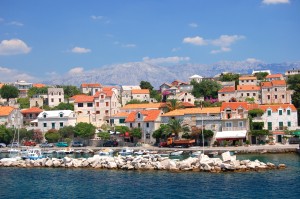
Sumartin: The fishing village and its harbour (since improved)
This small sleepy fishing village is a pleasant contrast to some of the more touristy places in Dalmatia. It’s a popular retreat for Croatians with second homes who appreciate the calm.
There’s not much here which is really the main attraction. There are a couple of pebbled beaches within about 20 minutes walk of the centre, and a handful of restaurants and cafe’s.
The village was formerly a Franciscan settlement, back in the early 18th century. Much of the population was wiped out in a plague in 1783-4 but the village recovered and adopted St Martin as it’s patron saint, after whom it is named. A monastery still exists where you can see a number of works of art.
For provisions, there’s a small supermarket, a tiny general stores, a fruit and veg stall which opens in high season. There are a couple of ATM’s as well but that’s about it. Definitely a place to escape to for some peace and quiet.
Continue reading →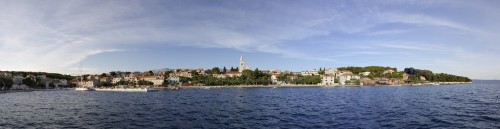
Sumartin: Panorama of the village and harbour looking north east
- Supetar (Brac)

Supetar: The town with cafes on the harbour quay
The main habitation of Brac and gateway to the rest of island, Supetar is a bustling traditional town. With plenty of alleys to explore, galleries to view, wine cellars to visit and restaurants to sample it’s a fairly typical Croatian coastal town.
There are no great architectural sites – nobody seems to have been that bothered about invading the place, but it’s a friendly spot. There are beaches just to the west of town but as the hub of the local transport network it’s also a good base from which to explore the island further.

Supetar: Panorama of the town looking south east with the ferry port far left
Particularly worth a visit (if you’re not already planning to sail there) is Bol on the south coast and it’s famous Zlatni Rat beach. It’s only about 10 miles by bus from Supetar. Supetar is also an easy place to drop off or pick up crew, with up to 20 ferries a day to Split in summer.
There are plenty of places for provisions ashore and several banks and ATM’s.
Continue reading → - SutivanContinue reading →

Sutivan: The village with its prominent tower rings the harbour
- Trogir
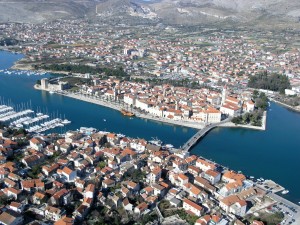
Trogir: Aerial view of the old town on the island showing the marina and long quay opposite
Trogir is not to be missed. A beautiful medieval town crammed with renaissance and Romanesque architecture, Trogir, oozes with an understated sophistication that will charm even the most jaded cynic. Moor your boat among the many other yachts than stop here and enjoy a night of revelry in surroundings of relaxed elegance.
A World Heritage Site described by UNESCO as “an excellent example of a medieval town”, the walled old town sits on an island originally know as the island of goats. Linked on two sides by bridges the old stone walled town of Trogir offer sailors several mooring options all within a short distance of the action and is very popular with yachts. Some charter fleets are based here as well.
There are several marinas and quays to choose from in Trogir. One of the most popular places is the ACI Marina but there is also the very modern Camper and Nicholson Marina and the Seget Marina. Trogir becomes very congested at the weekends so it pays to book ahead if possible.
ACI Marina Trogir is located in the south channel of the old town on the island of Ciovo. The approach from the west is simple but it is recommended that you don’t try and sail in. The channel silts and depths are an uneven 2 metres at best in some spots! The marina has 174 berths and all the facilities you would expect to need from a marina. For advice or help mooring up call on VHF channel 17. A 12m yacht will cost you 77€ for the night during July and August and 67€ at all other times (2016). It is only a short walk across the bridge to the old town from the marina.
The Camper and Nicholson Marina in Trogir is a recent development. Originally known as Trogir Marina the C and N Group bought the premises in 2014 and have been developing the former marina and ship building site as a superyacht destination ever since. Luxury is the name of the game here and the marina has top of the line facilities and only lacks a supermarket. Currently there are 133 berths but by the time they finish there will be room for over 250 yachts of all shapes and sizes. Surprisingly berthing rates are on a par with the next door ACI Marina.
Seget (Donji) Marina is part of the Seget Yacht Club and is located on the mainland, north and west of the old town of Trogir. There are approximately 100 berths available and although it is a longer walk to the old town there are plenty of facilities located around the marina itself if you don’t fancy the walk.
The town quay at Trogir is a very busy place indeed; plenty of mega-yachts and trip boats coming and going here! That being said yachts are still welcome to moor up on the south side of the old town every day except Friday. Pre-booking is easy. Phone: 00385 95 519 1631 or email: euronet.lukatrogir@gmail.com. In 2016 a 13m yacht cost 580 kuna/night (approximately 77€) and included water, power and rubbish collection. Yachts are required to notify the harbourmaster one day before arrival and call on VHF channel 10 or 16 before approaching the quay.
Anchoring is still allowed west of the bridge near the C and N and ACI marinas and on the mainland side near the Seget Marina but take care as there is a small tide here and depths are shallow. Anchor in 5 metres or more to be sure of staying afloat! You can also anchor on the east side of the old town.
Note it is not possible to traverse all the way through the channel between Trogir and the island of Ciovo as it is blocked by a low bridge. The northern channel is too shallow for yachts.
Once you are securely moored up it is time to explore Trogir. Made a UNESCO World Heritage Site in 1997, the old town of Trogir dates back to the 3rd Century BCE. Originally a Greek settlement, the tiny town was an important sea link to the ancient city of Salona but has since blossomed under many different rulers over the years. A major Roman port at one time, Trogir was also in the hands of the Venetians for 4 centuries and the myriad of Romanesque and Renaissance buildings are a sight to behold and unique in Croatia. Highlights include The City Gate and fortified walls, the 14th century Kamerlengo fortress which still guards the entrance, the 13th Century Cathedral and its Portal of Master Radovan and the city Loggia. You can leave your yacht in the marina opposite, or if you’re lucky, get a space right in front of Kamerlengo Fortress. For a small fee, you can climb the walls and scale the Cathedral’s Bell Tower.
Vertigo sufferers may prefer to enter the old town through one of the original gates and wander the alleyways to view the many medieval buildings and churches. The Benedictine Monastery at the church of St Nicholas houses the 3rd century BC Greek relief of Kairos (the god of a happy moment). Take the time to wander the back streets and narrow lanes to really appreciate how amazing this old town is.
You can also visit the ancient ruins of Salona from Trogir. They lie between Trogir and Split. Salona was thought to have been founded by the Illyrians and then expanded by the Greeks and Romans. Admission is 20 kuna and you can hire a guide for around 200 kuna to get more out of your visit. The site is largely unexcavated but Salona is still impressive in its size and scale. A small onsite museum houses some of the more impressive artefacts discovered.
Conveniently, many of the historic buildings are still in use and house restaurants and cafe’s where you can rest your feet.
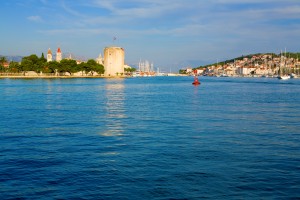
Trogir: The town from the west, with the Kamerlengo Fortress left and marina right
Either side of the island the more modern town provides a wide range of facilities with several supermarkets, butchers, bakers, a large daily market, medical facilities, banks and ATM’s. And of course, more restaurants and bars!
There are no beaches within walking distance but you won’t be short of things to do and it’s a great place to pull up a chair late evening and watch the world pass by whilst you sup your favourite tipple. Even if you’re not a fan of old buildings, Trogir is worth a visit.
- TucepiContinue reading →

Tucepi: The town at the foot of the Biokovo mountains
- Uvala Drvenik / Krknjas (Drvenik Veli)

Uvala Drvenik: The beach and village. Beware the swimming nets across the bay
Pretty little Uvala Drvenik (aka Uvala Krknjas) on Drvenik Island lies west of Trogir and Split. This luminescent turquoise bay is locally known as The Blue Lagoon and is an extremely popular place to anchor up for lunch, a swim stop or for a last night anchorage before returning your charter yacht to Trogir, Marina Agana or Split.
Uvala Drvenik has two mooring alternatives. Anchoring is possible in most parts of the bay but holding is patchy due to rocky outcrops and seaweed. The bottom comes up sharply close inshore and near the two eyelets so it pays to scout about slowly in these areas. When it is very busy you may have to be content with anchoring a little closer to other boats that you are entirely comfortable with or have others do so to you!
The other option for stopping is to pick up a mooring buoy. The restaurant lays these in the summer months. The number varies but there is usually a good half a dozen. However, when I stopped there in 2015 the restaurant did not stay open at night; therefore if you want an evening meal it may pay to check ahead of time.
There are no other facilities ashore in Uvala Drvenik. Provisions can be sourced on the other side of the island at Veli Drvenik but it is probably better to up anchor and head to Vinisce, Marina Agana, Trogir or Split if you need to stock up on anything.
While relatively well protected from the average prevailing winds Uvala Drvenik is no place to sit out a storm. The winds seem to change direction frequently on this island and can play havoc in the all the anchorages.
On a final note I must point out that the gap between the islets of Veli Krknjas and Mali Krknjas is passable depending on the draught of your charter yacht. The main “channel” is approximately 2m deep but due to the clarity of the water it will have you thinking otherwise. Looking over the bow the sand and pebble bottom seems much closer than that and can cause some heart palpitations! On the other hand the gap between Mali Krknjas and Drvenik island is not passable. Here the depth is a rocky and shallow 0.6m. The small jetty out from the restaurant also lies in shallow water.
Continue reading → - Uvala Splitska / SpliskaContinue reading →
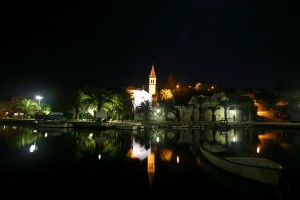
Splitska: The village annd harbour at night. You can moor side to on the quay
- Uvala StoncicaContinue reading →

Stoncica: The lighthouse provides a clear landmark showing the entrance to the bay
- Vela Garska (Vis)
Vela Garska is a natural bay on the south side of the west end of Hvar. Surrounded by pine slopes it’s a lovely spot, little reached by tourists other than those afloat.
There’s an underwater cave which makes it a popular diving spot. There’s a restaurant at the west end of the bay and there are mooring lines laid there. If you eat at the restaurant they will refund you for the mooring fees. However, it’s a fairly expensive eatery.
There’s no other development there. It’s well sheltered though there can be some wash from the super-yachts heading in to Hvar.
It’s a great place to chill out but if your wallet is feeling sensitive, it’s an ideal spot for a meal on board.
Continue reading → - Vinisce
- Vis Town / Viska Luka (Vis)

Vis Town: The town spreads around the bay. Yachts moor on the quay centre left
Vis is an island of contrasts. The more prosperous town of Vis languishes on the north eastern coast facing the its upmarket rival Hvar, while the hardworking fishing town of Komiza occupies the western end of the island.
Vis has seen more than its fair share of conflict. Since 3000BC Vis has played host to every passing nationality that has sort to get a foothold in this area.
The influences of all these cultures are represented in the layout and style of the island, with the Venetians providing a central backbone of grand buildings. More recently (1950’s to 1989) Vis was off limits to most foreigners due to its role as base for the Yugoslav National Army. As a result the island was a poor cousin to the neighbouring islands as they lined their pockets with the all might tourist dollar.
Now, however, Vis is one of the most popular destinations in the area and caters remarkably well to both land and sea based visitors. With the weather gods on your side Vis makes a wonderful destination to add to your sailing route but be warned… if the weather is unsettled Vis can be a very uncomfortable quayside for all concerned!
Vis has a delightful old town. The Italianate harbourside houses sweep majestically around the port of Vis (Lissa) complemented by a striking backdrop of high hills behind.
Vis offers everything you need in a harbour. A variety of restaurants, cafes and bars line the harbour front and there is a plethora of other shops. There is a definite sense that Vis is taking its lead from Hvar when it comes to town planning so be prepared for some higher prices than you would normally expect.
Both ends of the bay (known as Vis and Kut) offer quayside mooring and buoys or it is also possible to anchor. Anchoring is free as long and, as you don’t impinge on the mooring fields or the ferry turning circle, you won’t be hassled.
Unfortunately the other two options for mooring come at a fairly hefty price. For a 12m yacht the going rate is 252 kuna/night (approximately 34€ 2015) and the town quay will set you back 30 kuna/m plus an additional 160 kuna per night (approximately 56€ in 2015) Power and water is available but will more than likely cost you extra.
Both ends of the bay provide adequate protection in settled weather but can become choppy in the afternoon due to the high hills around confusing the afternoon sea breezes. If there is any chance of a blow from the north steer well clear of Vis. This is not the place to be caught out if the bora blows and even the Sirocco gains momentum as it sweeps down the hills and gullies. I once had to bunk out of this bay at 3am due to an unscheduled bora and as I bashed my way to windward I could hear the yachts clashing together as they had to remain, pinned to the quay by the wind and waves. Given a choice I would suggest you head for the moorings or anchorage north of the ferry quay. Here it is somewhat more sheltered and the tiny peninsula and church afford pleasant if somewhat more noisy surroundings.
There is not much opportunity for beachside swimming in Vis so you may want to stop for that last minute swim in one of the bays at the entrance to the harbour.
Vis has an interesting history and many palaces, fortresses and churches remain. the island also produces some great wines; particularly the vugava whites. Ruins from the Greek and roman occupation litter the countryside as do remnants pertaining to later invaders but none are particularly well marked or managed. Highlights include an amphitheatre visible on Gradina Hill (though don’t expect too much). The town has had spells under the Venetians (who left some fine buildings), the Austro-Hungarians, the French, the Italians and the British. In 1866, the Italians and Austrians held the first battle between ironclad battleships just offshore.
Walks crisscross the island. A rewarding one begins in the port and travels up steeply counter-clockwise to a war memorial before sweeping round the eastern side of the bay and depositing you for cool refreshments near Kut Church. If you are feeling slightly lazier, a bus runs between the pretty and lively fishing village of Komiza and Viz (Lissa). In Komiza you will find a fishing museum and the crumbling but picturesque ruins of a fort long since abandoned. In Vis there is a small archaeological and ethnographic museum which offers an interesting view of life on the island.
You can also visit the Blue Caves in Bisevo island from here.
May sees the carnival and amateur dramatics festival whilst concerts and theatre are put on through the summer months. There are several art galleries around town.
The town offers a supermarket, bakery, market, pharmacy, banks and ATM’s. You can also hire cars, scooters and mountain bikes – the island has good roads thanks to its military past. There are also a couple of dive centres in town.
Continue reading → - Vrboska (Hvar)
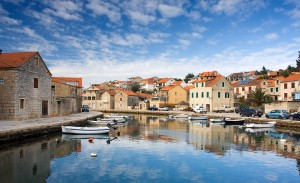
Vrboska: The canal through the town, known as Little Venice
This fishing village is known as “Little Venice” due to the canal with it’s low bridges that winds through the centre. For added authenticity, the Venetians actually invaded and left behind some appropriate buildings!
Vrboska is at the head of an inlet surrounded by slopes clad in pines, olive groves and vineyards.
The village boomed in the first half of the 20th century with the arrival of a large sardine factory but declined after its closure until rescued by the arrival of tourism.
As well as the charming village, visitors flock from across the island to the beaches on the Soline peninsula that forms the north side of the inlet. Though fine gravel or small pebble rather than sand, the beaches are backed by pines which make excellent sun shades.
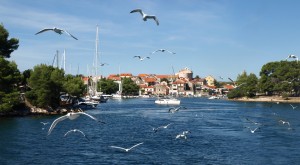
Vrboska: The town, with yachts on the quay left, and the Church (fort) of St Mary centre right
There are several beaches on the south side of the peninsular and a nudist beach on the north side, all within a mile or so of the centre of the village.
If beaches aren’t your thing, there’s an interesting Fisherman’s Museum in the village, including a reconstructed cottage which gives an idea how tough life was. There are also several churches to explore, including the Church of St Lovinac (St Lawrence) which includes an exhibition of art from the island. you can also take a look at the 16th century Kastilac Tower.
A range of provisions are available in town where there’s also a bank, ATM,Post office and medical facilities. A good selection of restaurants, cafe’s and bars complete the essentials list.
Continue reading →