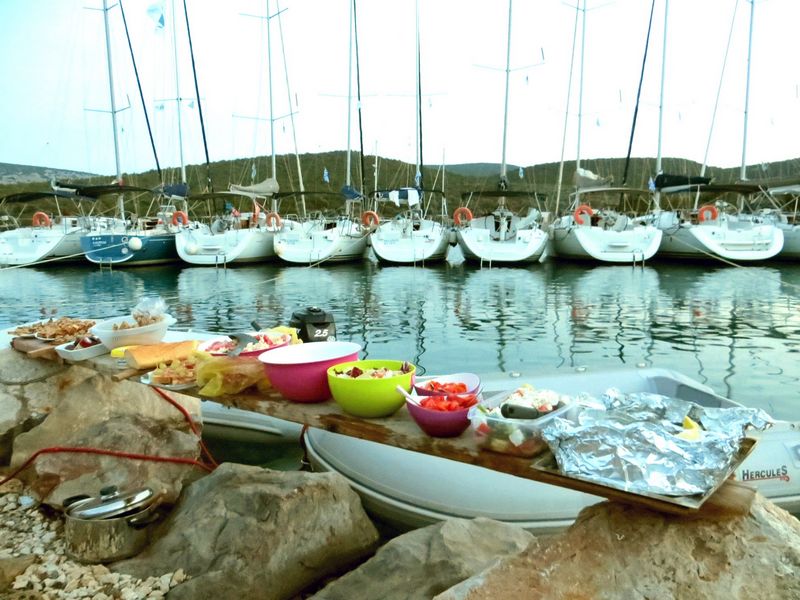
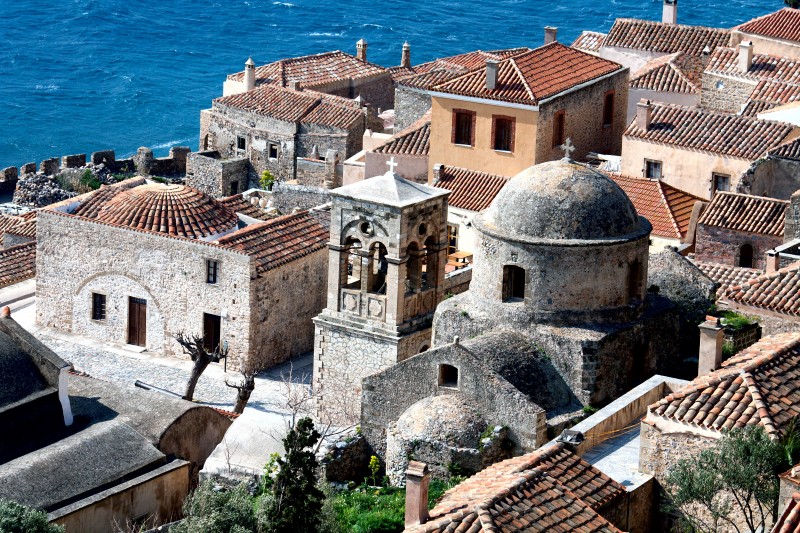
Full descriptions of all the popular Saronic ports, listed alphabetically.
- Aegina Town
Aegina town, on the island of the same name, is known for its pistachio nuts and natural sponges.

Aegina: Fruit and veg boats in the harbour
Alongside the harbour front cafes you’ll find an excellent fish market complete with several fish restaurants, and boats on the quay selling fruit and veg. One can’t help but think the fruit should be in the market and the fish on the boats, but that’s how it is!
Much of Aegina town is dedicated to the weekend tourist trade from Athens, with souvenir stalls in abundance and horse and carriages trotting up and down the quayside. The front is lined with restaurants and cafe’s and at night the noise from the bars may disturb light sleepers moored on the quay opposite. Those who prefer a quieter night should take a spot on the other side of the harbour.
However, Aegina isn’t just a tourist town. Step in to the back streets and there are shops selling everything from mobile phones to garden chairs. Head inland and there’s plenty to explore. There’s also good ferry service to Athens should you need to change crew.

Aegina: The monastery of Agios Nektarios
If you’re looking for gifts to take home, (or to consume during your trip), skip the usual tourist tat and buy some pistachios, which are still grown locally. (Note to skippers; the shells seem to have a mind of their own so discipline your crew before any consumption on board or you’ll be picking shells out of the bilges, lockers and everywhere else for the rest of the trip).
Natural sponges are also a good buy in Aegina, though they are unlikely to originate from the area, sponge fishing having died out.
There are several beaches around the island, the nearest, Avra, a short walk north of the harbour.
Culture vultures are well catered for too and if you fancy a day off sailing, Aegina is a good place for it.
Towards the centre of the island is the impressive monastery of Agios Nektarios, reachable by taxi or the bus to Agia Marina (which isn’t a marina)!
Adjacent to the monastery are the remains of the medieval village of Paleachora, previously the islands capital. These include 33 churches you can visit, all that’s left of the 365 that were allegedly once there.
Somewhat older is the Temple of Afia (or Aphaia), dating from the 5th century BC. This can also be accessed via the Agia Marina bus though there are only two a day.

Aegina: The Temple of Afia (Aphaia)
The cunning take the first bus (around 11.20 from the bus station next to the harbour) to the Temple, catch the second bus back to Agios Nektarios, from where there is a more frequent service back to town. Alternatively, why not hire mopeds and explore the island at your own pace.
If that isn’t enough, Aegina offers two annual festivals. An International Music Festival runs through August with events on Avra beach, just north of the harbour. For more details see the Music Festival website. There is also an annual Pistachio Festival (I kid you not) in late September.
Continue reading → - Agios Nikolaos
Agios Nikolaos is a bay on the south end of the island of Hydra. It’s only accessible by sea. However, you may not be alone – it’s a popular stop for water taxi’s from Hydra town.
There’s a small pebbled beach, equipped with sun beds and umbrellas. Snacks and drinks are available, provided by a friendly family run facility. However, as is usual on Hydra, it’s not cheap.
A small white painted church sits just behind the beach.
A nice place for a short stop or to overnight (so long as it”s not blowing from the south).
Continue reading → - Agistri / Angistri / Agkistri
The small island of Agistri offers a number of beautiful beaches. The cobbled streets and whitewashed house are picture postard Greece. Outside the settlements it’s olive groves and pine forests, which supply the resin used in making Retsina wine. Definitely one for your yacht charter itinerary and since the harbour has been developed, it now features on some flotilla routes too.
Most charter yachts head for the “capital”, Megalochori / Milos (population a few hundred) on the north side of the island. On the terraces above the town are the remains of the original settlement of Kadoudi / Kandouki, first settled around 5BC. It is believed the island is the place called Kekrifalia, documented by Homer.
Assorted finds from the terraces and elsewhere on the island an be seen in the Cultural Centre in Megalochori. Above the terraces is the church of Agioi Pantes, about 10 minutes from the centre of town, offering excellent views. If you don’t fancy the walk up hill, the church of Zoodochos Pigi in the town itself has some interesting wall paintings.
If you want to tick of the rest of the sights in Megalochori, you’ll need to find the “ancient” windmill, though it doesn’t look to ancient to me, and lacking any sails is rather unremarkable. You might prefer to just lounge on the sand and pebble beach.
Being a small island, its easy to explore either on foot or by hiring a bike or scooter. About a mile east of Megalochori is Skala, the main holiday location, with an excellent sandy beach. On the way, you’ll pass the small village of Metochi / Metohi where a short detour will take you to the church of Panagia / the Virgin Mary. There are good sunset shots on offer if you time it right.
Skala does have it’s own small harbour but it’s not recommended for yachts. We did manage to thread our way through the rocks to the harbour entrance, only to run out of water before we made it to the quay.
If you need further exercise and fancy letting it all hang out, another couple of miles to the south of Skala is the sheltered nudist beach of Halikadha / Chalikiada. I understand this is the only nudist beach in the Saronic. Follow the road south, continuing as it turns to a track and in due course you’ll find yourself looking down on the beach.
Back in Megalochori, you’ll find a selection of restaurants, a pharmacy, one of Angistri’s two cash points (the other is in Skala), and a number of shops that will provide basic provisions.
Finally, if you’re passing that way but don’t have to to stop for the night, the anchorage opposite the island of Dorousa at the west end of Agistri makes an excellent lunchtime swim stop.
Continue reading → - Astros / Astrous

Astros: Flotilla seen from the castle
A holiday town popular with the Greeks, Astros is really two towns; the commercial centre being a couple of miles inland. The port and beaches form the tourist centre, but the medieval castle on the headland demonstrates this is not just a modern settlement.
The town has numerous restaurants and cafe’s, and plenty of places to provision, all within a short walk of the harbour. The castle is well worth a visit, though wear some proper shoes. There is also a small archaeological museum for the culturally inclined.
It’s a pleasant place to wander and a good place to cool down, as there are often strong katabatic winds in the evening. You might want to take something warm to dinner if you’re eating out.
Continue reading → - Athens Kalamaki (Alimos)

Athens Kalamaki: Charter yachts to suit every budget
Kalamaki Marina is home to countless charter companies and is easily reached from Athens Airport, less than 20 miles (30km) away. It is also handy for the centre of Athens, 5 miles (8km) to the north. There’s even a beach next door.
That’s the good news. On the other hand, although it has improved greatly since the days when you had to step carefully to avoid the junkies’ discarded syringes, the marina has a run down air, being very much functional rather than glamorous.
The restaurant and bar on site are expensive. There are cafes on the beach but they tend to close once the crowds go home. However, central Athens is only a short ride away. The main coast road outside the marina has bus and tram stops which run in to the centre. Here you’ll find a great choice of restaurants in areas such as Plaka. And of course there are all the usual shopping facilities you’d expect of a city centre.

Athens: Trams run from Kalamaki in to the centre of the city
The city itself is of course blessed with a wealth of history and even if you’re not big on old ruins, you really should try to spend some time seeing the sights whilst you’re there, even if it means checking in to a hotel for a night or two.
Kalamaki serves two cruising areas; the Saronic and the Cyclades. Geographically, it’s not the best starting point for either when you could start in Poros, at the centre of the Saronic, Athens Lavrion which is closer to the Cyclades, or Syros or Paros, both in the middle of the Cyclades.
However, Kalamaki has two great advantages; its proximity to the Airport and the excellent transport links mean you can board your yacht half an hour after leaving the terminal, much quicker than you could reach any of the above bases (except Lavrion which is a similar distance from the Airport).
And the sheer number of yachts available exceeds any other base in Greece, albeit that I don’t rate the quality of some operators too highly. Let me know if you’re looking for the cheapest option, otherwise I will only offer you bareboat charters from the better operators – it doesn’t cost much more.
Continue reading → - Athens Marina Zea
- Dhoroussa / Dorousa
This small island lies at the west end of Agistri. The channel between these two islands provides several anchorages on the east side, popular with charter yachts.
At the north end a small cafe sometimes operates on the Agistri shore.
Continue reading → - Dokos / Dhokos
The island of Dokos, is a great place to escape from it all. Other charter yachts aside, the population of a few monks and shepherds only just make it in to double figures (though it’s getting more popular; there were only 11 of them in 2001 but 18 in 2011)!

Dokos: Flotilla beach party at Skintos Bay
The large bay of Skintos / Skindos on the north side offers a number of places to anchor. Many yachts gravitate to the east side where there’s a restaurant, though this doesn’t always open so I suggest you arrive suitably provisioned.
The bay is thought to have had a harbour in ancient times and the worlds oldest know wreck was found here in 1975. It has since been dated to around 2200BC. Nothing remained of the vessel itself but a large amount of cargo was found and is now with the Spetses Museum.
Apart from the restaurant, the only building immediately visible is the small church of St Nicholas, next to the beach. So if you fancy a quiet night on your bareboat charter, Dokos is the place (provided your visit doesn’t coincide with a flotilla’s beach party night)!.
Continue reading → - Epidavros / Nea Epidavros

Nea Epidavros: The beach
This small harbour is less known than the larger town further south at Palaia Epidavros. In fact Nea Epidavros town is rarely frequented by yacht charter crews, being about a mile inland from its harbour. The town is virtually invisible from the sea.
Nea Epidavros lies at the foot of Mount Akros. It is famed as the location of the First National Assembly of Greece, held in 1821 during the War of Independence against the Ottoman Empire. A monument in the town commemorates the event.
Nearby are the ruins of a Byzantine castle so you might deduce that the Nea tag (meaning “new”) is perhaps a little misleading. However, the original Epidavros, location of the superbly preserved amphitheatre, dates back to ancient Greek times. So it’s all relative!

Nea Epidavros: The quay
I highly recommend a visit the amphitheatre and extensive associated ruins. They’re within reach of Nea Epidavros, but closer to Palaia Epidavros. See that port’s page for more details.
The peacefulness aside, the main attraction of harbour at Nea Epidavros is the beach. There are a couple of restaurants to sustain you, which will provide bread next day, and a small kiosk. Unless you fancy a walk up to the village, bring anything else you need with you.
The town is founded on citrus and olive production, and fishing, but has aspirations to be a holiday centre. But for now it’s a worthy stop for your bareboat charter and used by a number of the flotillas. Don’t panic; there’s a fair bit of space and even if there’s a flotilla in, you shouldn’t have any trouble finding a spot.
Continue reading → - Epidavros / Palaia Epidavros

Palaia Epidavros: Harbour and town from the sea
The main reason to pause your charter yacht in Palaia Epidavros is to see the impressive and well preserved Greek amphitheatre which dates from 4BC and is still used for performances in high season. There is also a sunken Roman villa just off the beach. However, town itself is pleasant enough and offers several restaurants and shops supplying basic provisions, as well as a couple of excellent bakeries and a small beach. There is also a diving school.
There are no public showers but you may be able to persuade the hotel opposite the quay (behind the trees) to open a room for you. Mike/Maik’s restaurant on the front offers a good range of traditional Greek fare, as well as a nice spot for a beer as you watch the other yachts come in. There can be an uncomfortable swell running in to the bay during the afternoon but this generally subsides in the evening.

Palaia Epidavros: The Amphitheatre is in superb condition
The amphitheatre is renowned as the source for the saying “you can hear a pin drop” – the acoustics are certainly remarkable. Take a walk up to the top of the theatre and get someone to speak or sing from the stage to fully appreciate the genius of the designers who achieved 2500 years ago what modern sound engineers still strive for.
There are other ruins around the site so you will want at very least an hour there. These include the Temple of Asclepius, god of healing and son of Apollo, and a sports stadium and baths. Excavations are continuing to reveal more of the rich history of the site
The amphitheatre can be reached by taxi or you may be able to hire a moped in town. Some flotillas arrange coaches so you can also try to tack on to one of these groups – ask the Lead Crew. Taxis will take you up and collect you at a later agreed time.

Palaia Epidavros: Harbour and town seen from the beach
I would suggest you go late afternoon or early morning when it’s less hot and when you will also avoid the many coach tours from Athens. There never seem to be many taxis around so if going in the morning I suggest you book one the night before – just ask one of the drivers. Opening hours are around 8am to 7pm but the taxi drivers usually know the current times. Entrance to the site is 6€. Expect to pay around 25€ for the taxi (round trip).
The only time you might want to avoid Palaia Epidavros is on Fridays and Saturdays in July and early August, when plays are put on at the amphitheatre. Some of the great and the good arrive by sea and less well connected visitors may be asked to leave. You can see the programme on the Greek festivals website, once the programme is announced each spring.
The remains of the sunken Roman villa is just a few metres off Kalymnios beach. It’s only about 3m below the surface and the water is clear. Take a snorkel and mask for the best view.
Continue reading → - Ermioni

Ermioni: Fishing boats in front of Limania
This bustling town, built on a peninsula, seems to be a latecomer to tourism. The north side of the peninsula, known as Limania, provides the harbour and all the facilities you would expect of a small town, including chemists, excellent bakeries, banks with ATM’s and various general stores. There’s even a small hypermarket within walking distance.
South of the peninsula, known as Mandrakia, where you can also moor, is a paved sea front with a cluster of bars that open until well in to the night, if trade dictates, though it seems supply sometimes considerably outstrips demand.
It’s just a few minutes walk between Limania and Mandrakia, though if you don’t like hills you might want to stroll a few minutes towards the end of the peninsula first.

Ermioni: Boats in the fishing harbour
There are a number of restaurants and if you fancy a little exercise, some pleasant walks to the end of the peninsula where there are also places to swim, though no beaches. If you can plan you visit accordingly, there’s an interesting market every Thursday morning, selling everything from local produce to clothing.
All in all, it’s a place I never long to visit, yet always provides a very pleasant stop (and I don’t think it’s just the attraction of the bakeries though I wouldn’t miss my Ermioni pie for anything)!
The town may soon change, with plans afoot for a 120 boat marina taking yachts up to 65m. Building is due to start in 2013 with opening early in 2014, which sounds an ambitious schedule even in less harsh financial times. Time will tell.
Continue reading → - Fokianos
Fokianos is a bay about mid way between Plaka and Kiparissi. The long pebbled beach stretches around the clear waters of the bay. There are a few (free) sun loungers and umbrellas.
The beach sees few visitors, due to its relative inaccessibility. So you can have a section of beach to yourselves. There are however enough visitors to support a couple of restaurants.
The road to the bay has been improved recently and a few houses have appeared. I fear this beach my not be so peaceful in a few years time. One to visit sooner rather than later.
Continue reading → - Hydra

Hydra: Harbour view with yachts rafted out (as usual) on the north quay of this busy port
Hydra is a must see destination for any Saronic Cruise. The former artists colony still relies on donkeys to transport everything from food to fridges along the cobbled streets, the only mechanised transport being a couple of dust carts. The bustling harbour is ringed with restaurants and gift shops selling everything from tacky souvenirs to highly priced designer attire and artworks. Yet step in to the streets behind the front and the town oozes Greek charm.
Development has been strictly controlled so the few new buildings are indistinguishable from the old. This, and geography, has kept the town focussed around the small natural harbour.

Hydra: Donkeys await their next load
Walks up the hill to the old town, or along the cliffs provide great views with a smattering of cafe’s, bars and restaurants to reward your efforts on the way back down. You can then cool off with a swim off the rocks around the corner from the harbour.
The harbour is constantly a hive of activity with hydrofoils and fast catamarans from Poros, Spetses and Ermioni, the occasional mini cruise ship from Athens, water taxis scooting in and out, trip boats, fishing boats, the cargo “landing craft” that delivers supplies, and of course yachts, all jostling for position.
The intense traffic on such a small harbour can make visiting by yacht a nerve racking experience but it’s fine as long as you take things steady, have your crew keeping a good lookout, and assume everyone is out to get you!! Just accept that crossed anchors are almost obligatory and press on, slowly!

Hydra: Harbour entrance from the west
It certainly doesn’t deter other yachtsmen – in high season you will be lucky to get a place on the quay with rafting out being the norm to the extent you can almost walk from one side of the harbour to the other across yachts. I counted them 8 deep on one visit. Even in low season, quay spaces may disappear in the morning as those leaving are rapidly replaced by new arrivals.
But don’t be put off visiting. If taking your yacht in all seems too much I suggest you moor in Poros or Ermioni and catch a ferry down. I definitely don’t recommend anchoring in Mandraki Bay just down the coast which has several underwater cables that will trap your anchor and pretty awful holding everywhere else. You would be unwise to stop there and crazy to leave you yacht if you did.
However you get there, I’m sure you will love the place, whether you choose to flash the credit card on an exorbitant luxury, or just sit quietly soaking up the atmosphere.
Continue reading → - Kapari
Kapari is a bay south of Ermioni. The small beach has sun loungers. There’s a good taverna nearby.
There’s nothing else here but if you need provisions just follow the rod round the by to Ermioni. It’s about 3 miles.
Continue reading → - Kiparissi

Kiparissi: Typical buildings beneath the mountains
With it’s low lying white buildings set against the green mountains behind, this fishing village provides an impressive stop.
A few holiday rentals have appeared and the bar on the front is popular in high season but otherwise the bay is untouched by the tourist trade and I hope it will stay that way.
The basics are all there for you though, with a choice of restaurants and simple provisions, though there’s no ATM .
There’s a long beach to enjoy, a little gritty but usually with few occupants. There are also some pleasant walks around the bay. Otherwise, it’s a place to relax with a beer and watch the world go slowly by.
Continue reading →
Kiparissi: A small octopus reaches the end of the line
- Koiladhia / Kilada
If you like fish, don’t miss Koiladhia. This is a working port and fishing is one of the two main occupations, so you can dine out on the local catch at one of several restaurants.
The other business in town is boat building and repairs, with a substantial boatyard dealing with a variety of craft, yachts included.
Koiladhia is a working town, rather than a tourist hub, so it’s not the prettiest place you’ll see. There is a certain honesty and friendliness about the place though and the handful of shops will cater for your basic needs.
Worth a visit are the Franchti Caves on the north side of the bay. These have yielded human skeletons going back to pre-historic times, including one believed to be the oldest in Greece.
Continue reading → - Korfos
A pretty village set in a well sheltered bay, Korfos offers few facilities beyond a clutch of restaurants and bars, and basic provisions, but is worth a visit.
Unusually for the area, the quayside is controlled by the two restaurants who have laid mooring lines. Use their quay and you’re expected to use their restaurant. It’s a few years since I was last there but George at Stavedo, the western most of the two always bent over backwards to make us happy. The name of the place next door escapes me but suffice to say after several episodes of creative billing we gave it a wide berth.
Continue reading → - Marathonos
Marathonos is a bay just north of Perdika on Aegina island. There’s a small beach in the south east corner and several restaurants ashore. However, for more atmosphere, Perdika is only about a half a mile walk away and is highly recommended for a visit.
Marathonos offers fairly good shelter, especially in the south east corner. It’s a usable retreat if you find Perdika is full. But to me, if there were a choice, I’d take Perdika every time.
Continue reading → - Methana
Methana is popular with Greek tourists, many drawn by the therapeutic sulphur springs. Bareboat charter yachts are less frequent visitors, many I suspect put off by warnings in the pilot book about the smell. Those who have braved it seem to agree the odour is greatly overstated and rather a non issue.
The town sits on the east side of a volcanic peninsula. Fortunately none of the 32 craters are active; the last eruption was nearly 2000 years ago. There’s a good walk up to the largest crater but it starts about 5 miles out of town and a better starting point is Vathi.
The sulpur springs tend to appeal more to a certain generation, making the town feel like a smaller Greek version of Bournemouth. I’ve never managed to find the baths open but a friend who did described it thus:
It’s rather like I imagine a Russian psycho ward would be; all hard faced women in white with cigarettes hanging out of their mouths, and scary rooms that fill with water. I quite enjoyed the experience myself!
If that doesn’t appeal, I’d suggest you hire some wheels and go explore the interior (where there are of course assorted ancient ruins), visit one of the several nearby beaches or just relax in one of the sea front cafe’s.
The marina is south of the town and you’ll usually see the masts long before you find the entrance. The mooring lines are caked in sulphurous mud so prepare to swill off the foredeck (and foredeck crew)! When the marina is full, it is usually possible to moor in the ferry harbour in front of the town.
Continue reading → - Monemvasia

Monemvasia: The fortified lower town on the rock
Monemvasia is a fantastic place, a fortified Byzantine town full of zigzagging alleyways perched on a 300m high rock connected to the mainland by a narrow causeway. A walk through the streets (and there’s no other way to get through them because of their narrowness) is like going back hundreds of years, though perhaps the cafes and craft shops weren’t as plentiful in medieval days!
Back then, the inhabitants were a religious lot and the town contains over 40 churches, including at the top, the Agia Sophia. The top was also used for farming.

Monemvasia: One of the many Byzantine churches in the walled fortress town.
The rock had mixed fortunes with spells under Greek, Venetian and Turkish control. In recent years there has been much restoration and it is to be hoped the restorers don’t go too far and remove the mystique of the place.
The town is split in to two parts, the lower and upper towns. so there’s plenty to see for the less fit though the views for the top reward those who are prepared to stretch their legs and walk to the top of the rock.
Continue reading → - Nafplion / Navplion & Mycenae
Nafplion, at the head of the Argolic Gulf, was previously the capital of Greece. The walled city had spells of Venetian and Turkish occupation, both of whom left their mark in the elegant architecture that remains today.

The Palamidi fortifications also remain, ringing the town and offering great views for those who can manage the 1000 steps to the top up the front, or a short taxi ride around the back. For culture vultures, the ruins of Mycenae, including its excellent museum is less than 20 miles away.
The mild (by Greek standards) climate and narrow shady streets, many pedestrianised, makes exploring the old town a pleasure. There’s a good choice of restaurants and cafe’s, and you mustn’t miss an ice cream or sorbet at the small shop at the rear of Philelinnon Square, the main square on the sea front. The coffee there is pretty good too.

The quayside has a reputation amongst foreign sailors for being smelly which is wildly overstated. True, I don’t have the most sensitive schnozzle, but friends equipped with better nasal gear confirm the smell is rarely noticeable and soon forgotten when detected. If you’re concerned, take a trip to the Komboloi Museum in town where you can view 1000 different worry beads. Replicas are available to buy to take your mind off things!
The town also has Archaeological, Folklore and War museums. As well as being the first capital of modern Greece, Nafplion was also scene of the murder of the first Governor who was shot in the Church of Agios Spiridon in 1831. The bullet marks can still be seen.
If you’re looking for a beach or watersports, you can take a short (5 mile) cab ride to the tourist town of Tolo. Alternatively, there’s a good beach in Ormos Karathona, a couple of miles south of Nafplion, where you can anchor on the way to or after leaving Nafplion. For the fit, Karathona is walkable from Nafplion.
Mycenae

The ruins and museum at Mycenae are about 45 minutes taxi drive from Nafplion and can also be reached from Argos. Check with local travel agents if there are any trips running, otherwise hop in a cab.
Although the ruins are not nearly as extensive as say those at Epheseus, they are worth a visit. The small museum on the site is superb, with case after case of amazingly well preserved artefacts and jewellery that dates back thousands of years. We got quite blasé – “look that one is only 4BC, it’s almost new”!
The citadel has been traced back to the Neolithic period (pre 3000BC) and once extended way beyond the fortified centre that is the focus today. Although abandoned by Roman times, the city was previously a thriving commercial and arable centre as well as having an important burial ground which has yielded a number of tombs. Excavations began in the 1870’s and continue to this day.

As well as revealing substantial remains of the buildings, the archaeological finds span a huge time period, giving a taste of the development of civilisation over the three thousand years up to the start of Christianity.
I’m not big on old relics but even I found the ruins interesting and the museum most absorbing, so it must be pretty good! And if you fancy a break from the culture for a few minutes, just sit and enjoy the museum’s fantastic air conditioning!!
Continue reading → - Perdika
A charming fishing village, Perdika is one of my favourite spots in the Saronic, with it’s row of restaurants on a terrace overlooking the harbour. Believe it or not, it also boasts the world’s first 360o camera obscura, essentially a huge pinhole camera giving an all around view.

Perdika: The harbour, anchorage and village looking north
Like many Greek villages, Perdika also has some ruins but in this case rather more recent. During the second world war, the original village on the south side of the bay was converted in to a German base and a strolling amongst the remains, the trenches and bunkers are still very evident.
On the north side of the bay, the location of today’s village, a line of restaurants and cafes sits on a high terrace overlooking the harbour, an excellent spot for watching boats coming and going. Shopping facilities are very limited – you’re as likely to find a child’s fishing net as a lump of cheese in the general store, though there is a small bakery.
There is a small beach at the back of the harbour but I wouldn’t recommend swimming from here due to residues from the many assorted vessels. Much better to swim off the rocks just outside the harbour.
Continue reading → - Petrokaravo

Petrokaravo: Swimming at the large anchorage
This large bay at the north end of Spetses offers plenty of space. Off the west side of the main bay is a smaller inlet with a restaurant. The main bay is often used by flotillas for beach parties but there’s plenty of room for everyone.
Continue reading → - Plaka / Leonidion

Plaka: Almost the whole village in one picture!
The small village of Plaka on the west side of the Argolic Gulf has long been a popular stop. The village has three or four restaurants, a small shop and a long and sparsely occupied beach, with a beach bar.
There’s a small hotel and a municipal shower block just a couple of minutes walk from the quay, just behind the port police office.
Bizarrely, there’s also a nightclub which on Saturday nights draws crowds from Athens, three hours drive away. However, apart from odd nights when flotillas are in it doesn’t open during the week so light sleepers have little to fear.
If you need anything else, such as an ATM or more extensive shopping, you’ll need to catch a taxi in to the town of Leonidion, a couple of miles away – the restaurant next to the main square will call one for you. It’s fairly unremarkable town but offers a good range of facilities.

Plaka: The beach and cafe bar
The harbour was extended a few years ago, courtesy of an EU grant. After several delays, the work was finally done through one summer with the apparent aim of causing maximum disruption (the first things to go were the mooring rings), allegedly in retaliation for the village’s failure to vote for the local mayor!
The extended quay increased both the space and shelter, though made the quay which was already a bit high for yachts, even higher!
Sadly, a huge storm in February 2012 caused major damage to the quay and given how long it took to make the original extension, it may be some years before the damage is repaired. Meantime, the mooring space available is somewhat reduced.
The two restaurants at the head of the harbour vie fiercely for trade and you may find yourself being accosted as you wander along the quay, though there’s little to chose between them. The pizzeria near the beach and the restaurant on the opposite corner are less forceful in their sales technique but equally worth a visit.
Continue reading → - Poros
The small town of Poros, which bears the same name as the island, is only 30 miles from Athens but a world apart.
Poros: Sunset over the West Quay, pontoon (since expanded) and Navy Bay A popular retreat for Athenians, the island retains it’s “Greek-ness”, with a range of traditional restaurants, a fish market, and good selection of small shops providing the necessities of life.
There’s also a good range of souvenirs, which are cheaper here than on the more touristy islands of Hydra, Aegina and Spetses. There is a choice of beaches close by, served by local buses, with water sports available for those that wish.
The town is built on a hillside, so for some superb views (and excellent exercise), take a walk up the hillside to the clock tower which overlooks the bay, or hire bikes and explore the almost deserted north side of the island.
Culture vultures will also want to visit the ruins of the Sanctuary of Poseidon, a few miles in land, as well as the small museum on town. There is also a monastery but it is not open to the public.
Poros: The Sleeping Lady of Poros As the sun sets, look out for the Sleeping Lady of Poros, as the outline of the hills makes the shape of a reclined and rather well endowed female (albeit these days with some wind turbines on her belly)!
For those seeking some night life, there is an assortment of bars and a few small clubs on the front, with a larger club up on the hill at the east end. Those wanting to enjoy their sleep will be pleased to know the clubs are well away from the main yacht pontoons at the west side of town. The sole yacht base is reasonably quiet too.
If you want to get out to the beaches, either anchor off, or take the buses from town. There are two buses; the white one heads east, out to the Monastery with it’s nearby beach, via Askeli, one of your options for water sports. The green one heads west to Neurion and Russian bays. They usually run hourly on the hour, though you may find the financial crisis has reduced the frequency. There are no bus stops – just stick out your hand to flag one down.
If you’re fit, the beaches are walkable from town, though those in urgent need of a swim can do so off the rocks a couple of hundred yards past the east end of the quay.
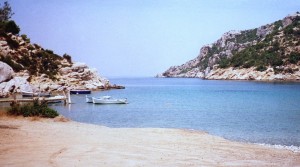
Poros: Vagionia beach on the north side of the island If the buses aren’t running or you want to head inland to the Sanctuary of Poseidon, there are taxis or you can hire mopeds and quad bikes from near the west quay and the new pontoons. Once away from the town and it’s beaches, it’s a very quiet place and the north side of the island is completely undeveloped. If you’ve got transport, you will find the beach at Vagionia Bay almost deserted.
For such a small place, there’s a good range of shops, including a couple of excellent cake shops for those wanting to take some traditional Greek deserts home. Restaurants offer everything from gyros (kebabs) and pizzas, through traditional Greek tourist fare, to tapas style offerings, giving you the chance to try a number of small portions of fish, meat and vegetable dishes.
Finally, if you want to visit Hydra or Spetses, but don’t fancy battling for space in these two busy harbours, Poros has a good hydrofoil service to both islands, so you can leave you yacht and have a day off sailing.
Poros is an excellent start point for your Saronic or Argolic Gulf yacht charter, or if you’ve chartered from Athens, a must see destination.
Continue reading → - Porto Heli / Port Kheli
This large almost totally enclosed bay is a popular water sports centre, though popular with bareboat charter skippers more for the excellent shelter.
Porto Heli offers copious mooring space, courtesy of the long quay built when the bay was intended to become a NATO base. A sandy beach runs along the north shore in front of a line of hotels and in summer the waters are full of water sports enthusiasts in their various forms.
The wide quay and road in front of the town make the town feel a bit of a sprawl. There are some nice buildings but the place somehow lacks a centre. That said there’s everything here that you’d expect of a small tourist town and though some of the activities afloat will be restricted to the customers of the hotels that provide them, you’ll have no trouble finding something to keep you occupied.
Continue reading → - Salamina
Salamina is the main town on the island of Salamis, the nearest island to Athens. The town surrounds the fishing harbour. The island is famed of the location of a historic naval battle in 480BC when the Greek fleet fought off the Persians and thus purportedly saved western civilisation.
The town is on the prettier west side of the island, shielded from Athens. Whilst it has a slightly functional feel it’s not without its attractions. There’s an excellent fish market and next door a fine ouzeri where you can wet your whistle. There’s a good bakery and several fine restaurants which draw diners over from Athens. There’s even a small museum.
Salamina probably won’t be the highlight of your trip to the Peloponnese. But it’s often overlooked by the yachting fraternity which is a shame. It’s a much nicer place than you might fear if you read Heikell’s pilot book.
Continue reading → - Sambateki / Sabateki
A new destination for yachtsmen, following recent construction of a breakwater across the bay. Let’s hope it lasts longer than the harbour at Plaka!
Sambateki is a small village with limited facilities though this may change if it becomes popular with sailors. There are a couple of tavernas so you won’t starve, and you should be able to get basic provisions but that’s about it.
I’ve not yet managed a visit so if you’ve been there I’d love to know what you think of the place.
Continue reading → - Soupia / Frog Island
The island of Soupia looks like a frog when approached from the east, hence its alternative name. Behind the island is an anchorage.
Continue reading → - Spetses Town
If your yacht charter was conditional on including some retail therapy for your nearest and dearest, then Spetses could be the answer. There’s a choice of beaches for the youngsters, fine restaurants, and a good choice of bars to party the night away. The town centre is car free, there are excellent walks, so why do so many bareboat charter skippers sail on by?

Spetses: A local resident in the sculpture park
Spetses was once a major trading centre, and the ship owners brought great wealth to the island. Many of their 18th and 19th century mansions survive today, often as holiday homes.
The islands merchant fleets played a major role in Greece’s war of independence in the early 1820’s. Rapidly converted to fighting ships, they provided a ready made navy. The ships included those belong to war heroine Bouboulina, who’s house is now a museum.
Spetses was once a popular package tour destination but in the 1990’s it decided to move up market. It’s now a popular destination for rich Greeks and very much a place to be seen. Ideally of course one should arrive by yacht!
The problem for bareboat charter yachts is where to moor. The recently extended quays in front of the town are often kept clear for the ferries and cruise ships. So most yachts head for Baltiza Creek, south of the town, only to find the quays jammed packed with local boats.
It is possible to anchor in Baltiza but the water taxis that whiz in and out during the day can make it a roly experience. And if you go ashore on the east side it’s bit of a hike in to the town centre.

Spetses: The town
However if you can get in, the town is a nice place to promenade, and for the more energetic, there are some good walks around the island.
Tourists are prohibited from bringing cars and even the locals are forbidden from taking cars into the centre. The result is there are even more scooters than in the average Greek settlement so watch out as you wander around!
Bikes and scooters are available for hire but donkeys are also available, or you can try to find one of the fairly limited number of taxis.
Then all you’ve got to do is watch your wallet. No, not because of thieves; if you promised your beloved not just a trip to the shops but an actual purchase, you’ll find there are some seriously expensive boutiques!
Continue reading → - Tiros

Tiros: One of several beach restaurants with the quay right
A sleepy village that stretches about a mile along the seafront of the large bay. In high season, it is a popular destination for Europeans, but even then, with the yacht moorings right at the south end of the bay, you’re unlikely to be disturbed.
The sea front is dotted with restaurants along it’s length so you don’t have to walk far from the yachts. There are also several mini markets where you can restock and at a greater distance, a cash point.
The narrow beach extends right around the bay but is pebble. A number of the restaurants use it as a dining area, sometimes complete with beach barbecue.
Tiros isn’t a place to set the world alight but it’s a pretty enough place to chill out with a book and a drink and watch the world go by.
Continue reading → - Tolo
Tolo was once a small fishing village. But blessed with a 2km long beach it was only a matter of time before it was discovered. It’s now a popular tourist destination. Fortunately, with such a long front the hotels are well spread and not of the high rise variety.
The town boasts all you would expect of a holiday destination. There are countless restaurants, bars and cafes, and the odd spot where you can dance the night away. It’s all done in subdued Greek style with no olde English pubs or teens out to drink themselves to oblivion.
If you fancy some culture, a walk from the harbour at the south end of the beach to the north end brings you to the ruins of Ancient Assini. As Greek ruins go, they’re not spectacular, only being discovered in the 1930’s. Excavations continue and there are facilities for youngsters to have a go.
Continue reading →
The small harbour at Tolo is often full of local boats so you may well have to anchor. And if you’re looking for a more tranquil setting or better shelter from the westerlies, I would head a few miles further east to Vivari. - Tselevinia / Skillaion

Tselevinia: A very pleasant anchorage
Just south east of Tselevinia is an pleasant anchorage, ideal for breaking the trip between Poros and Hydra or Ermioni. There’s nothing there so not much more to say really!
Continue reading → - Vathi

Vathi: The village and harbour
Vathi is a sweet little place with just three or four restaurants, no shops, one bar and a volcano (inactive)! It’s a small fishing harbour with limited space so one to avoid on Friday and Saturday nights when it gets over run with boats out from Athens for the weekend.
The first couple of restaurants nearest the harbour mouth are unremarkable but the third is a gem. The lady grows many of her ingredients and she may take you out the back to meet her chickens.
It’s a friendly laid back little village, if a little hicksville. One member of my team christened it the land of the six fingered banjo player, which is perhaps a little harsh but gives a flavour of the place.
There really are no shops (though the vegetable van may call by) and it’s a fair walk over the peninsula to Methana so make sure you are adequately provisioned before you arrive. There’s water on the quay and an open air shower.
There’s a functional but rather gritty beach just south of the harbour which provides a better swimming venue than the harbour. Highly recommended is a walk up to the volcano, a fact that seems to have escaped all my hostesses over the years. Wear some decent footwear though – this is not sandal country.

Vathi: The unusually empty harbour
Vathi will always stick in my mind as the only place I’ve ever had to put a yacht aground to stop it sinking (not my boat I hasten to add). It says something about the place that the restaurateur didn’t bad an eye lid when we ran in and whipped a cloth off a table to bung up the split transom!
It was also my first ever stop as a Flotilla Skipper, and I had the joy of being cheered on by the locals as I did battle (verbally) with the Athenian owner of a large motor yacht whose lines were blocking half the harbour. I eventually prevailed but it wasn’t the easiest start to my skippering career!
- Vivari / Khaidhari
The village lies at the head of a superb natural anchorage offering good shelter. There’s not much here, just a few restaurants, a beach and some basic provisions, but it’s a little off the beaten track and I’ve always found a warm welcome here.
Quay space is very limited so be prepared to anchor and dinghy ashore.
Continue reading → - Yerakas
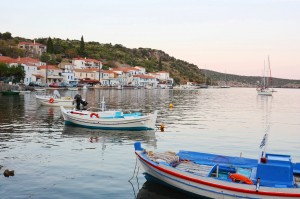
Yerakas: The quayside and village
This delightful fishing village is little more than a row of houses (and a couple of restaurants) lining the quayside. Other than visiting sailors, Yerakas sees few visitors, and indeed quite a few yachtsmen manage to sail past the well concealed entrance!
Yerakas is set in a long inlet, described by some as a fjord (they’ve evidently not seen a real fjord), providing good shelter.
Other than the village itself, the only notable point of interest is the ruins of the Mycenaean castle on the top of the headland and walkable from the village. The ruins are not that remarkable but it’s worth getting up there for the view.
Continue reading →