


Rhodes Town: St Angels Tower looks over the ferry harbour, with the walled city behind
If you’re hoping to see one of the Seven Wonders of the World, the Colossus of Rhodes, I’m afraid it collapsed in an earthquake around 226 BC, having stood for only just over 50 years.
No matter, Rhodes has plenty to offer, including copious Roman ruins, one of the best preserved walled Medieval cities, the Italian built Art Deco “new town” and of course plenty of beaches and endless shops.
You can’t avoid the Medieval city, and with its cobbled streets lined with souvenir shops, cafes, bars and restaurants, you don’t need an interest in history to enjoy it.
The walls and the huge gates were build by the Knights of St John and within them, besides the myriad retail opportunities, you’ll find the Roman Temple of Venus, the Palace of the Grand Masters, countless mosques and churches, including the Mosque of Suleiman the Magnificent, and several museums.

Rhodes Town: Entrance to the Palace of the Grand Masters
The Palace of the Grand Masters, originally build by the Knights was partly demolished in grand style in 1856 when dynamite stored there exploded. It was rebuild during the Italian occupation in the 1930’s as a holiday home for the Italian King, and later, Mussolini.
The Palace is now a museum, with many of the rooms open to the public and displays including mosaics, sculptures and frescoes covering both ancient and medieval Rhodes.
Leading away from the Palace is Knights Street, a cobbled walkway along which lie the inns of the Knights, again restored by the Italians. Wandering on through the alleyways there are Gothic churches and the Square of the Jewish Martyrs, commemorating the local Jewish community, crushed by the Nazis.

Rhodes Town: One of the many souvenir shops in the old town
Also in the Old City you’ll find the Archaeological Museum, located in the Hospital of the Knights. Here you’ll find relics from sites around the island. There’s also the Municipal Art Gallery, and the Jewish Museum. All in all, probably more museums than you need!
As you stroll through the Medieval City you’ll never be far from refreshment, though sadly much of what is on offer is something of a betrayal of Greek cuisine. It’s much the same in the souvenir shops – there are some nice items but there’s a far amount of tat to dig through.
Outside of the walls you may fare better (or maybe not). Next to the harbour is the New Agora, an Art Deco fascade built by the Italians (they didn’t just do restorations)! behind which lie courtyards with restaurants and markets stalls.
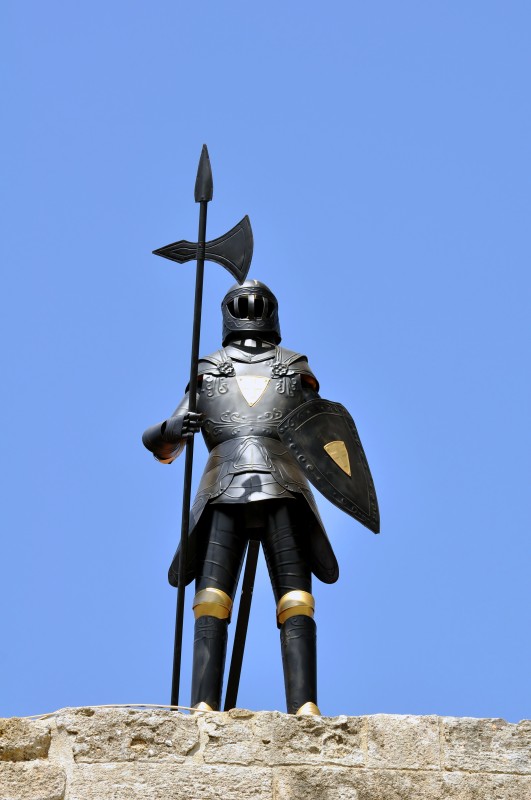
Rhodes Town: A knight in armour guards the walls
If you’ve still not had enough history, catch a cab a couple of miles west of the old city where you’ll find the Acropolis. The vast remains of the Roman settlement are still being excavated (they didn’t start until early last century), but amongst the building already found are the Temple of Athena Polias, the Gymnasium, the Stadium, the Odeon and the Library.
If that’s not enough, in the modern town you’ll also find a theatre, a casino, and a good range of shops. There’s also the Aquarium where you can see the fish you’ve been swimming with (and a few you haven’t)!
Of course, the main reason most people go to Rhodes is for the beaches. You’ve plenty to chose from around the island but the nearest to town is Elli beach, at the north top of the town near the Aquarium. Its position does mean it gets busy and if you fancy somewhere quieter you might want to hire a scooter or hop on a bus and head somewhere more remote.
There’s plenty to occupy you in Rhodes and it’s a very interesting place to explore for a day or two. You’ll not be alone though – the secret is out. It has however survived the tourist onslaught better than other places on the island


